Key Principle
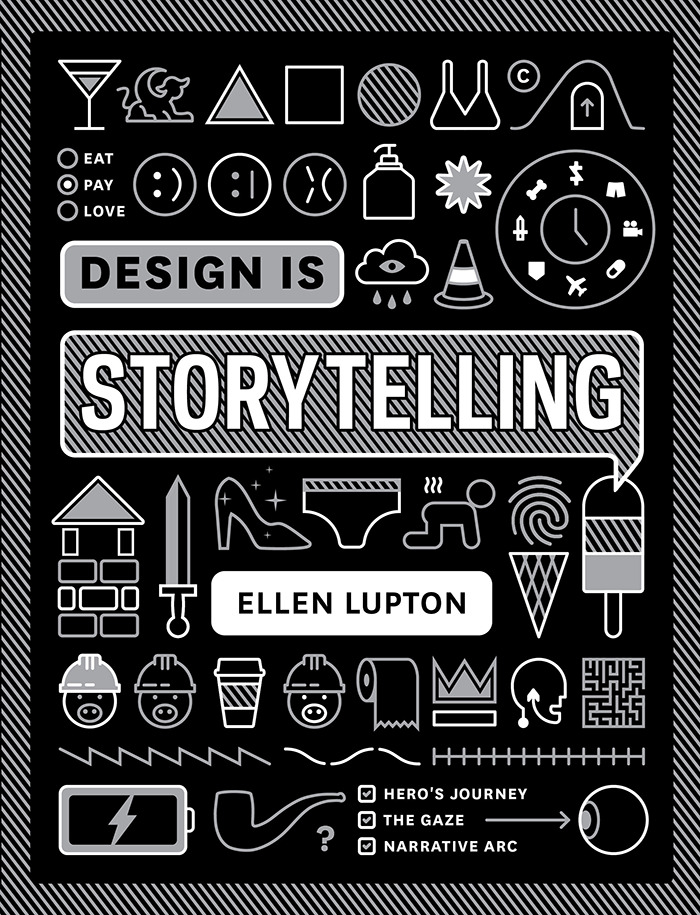
These are the collected actionable heuristics from Design Is Storytelling by Ellen Lupton (2017). Use as a checklist, audit tool, or quick reference when designing experiences, products, services, or communications.
Act 1: Action (Structure & Narrative)
- Map every experience to Freytag's arc: Exposition, rising action, crisis, climax, denouement. Without this shape, experiences feel flat and forgettable. (pp. 20-23)
- Nest smaller arcs inside larger ones: Each micro-interaction (button click, page load) is a sub-arc feeding a macro-arc (onboarding flow, full visit). Complex experiences maintain momentum through fractal arc structure. (p. 23)
- Distinguish plot from story: Plot is the causal structure (sitemap, information architecture); story is the order of revelation (user journey). Build both -- they are not the same thing. (p. 19)
- Ask "what actions does this enable?": Reframe artifacts as action-enablers. A calendar is not a list but a tool for mapping time. If you cannot describe the offering as an action, the design is inert. (p. 19)
- Ensure magnitude: Trivial problems yield trivial experiences. Without real stakes and genuine obstacles, no amount of craft sustains engagement. "Stories ask questions and delay the answers." (p. 19)
- Insert deliberate pauses before climax: Controlled delay builds uncertainty and amplifies emotional release. A roller coaster designer inserted silence before the apex to trigger suspense. (p. 16, via Beckerman)
- Use the labyrinth, not the maze: Guide users along a single path with controlled disorientation rather than genuinely losing them. Labyrinths feel adventurous; mazes cause anxiety. (pp. 26-28)
- Break symmetry to guide movement: Asymmetrical layouts move people in more controlled ways than symmetrical ones. Apparent order creates behavioral chaos; apparent complexity creates behavioral order. (p. 31, via Bayer & Moholy-Nagy)
- Make users protagonists, not passengers: Active protagonists who shape events produce satisfying stories. Passive protagonists who suffer events produce empty ones. Test: does the user make meaningful choices? (pp. 36-37)
- Verify the five story ingredients: Arc (progression), Change (transformation), Theme (greater purpose), Coherence (relevant details), Plausibility (believable within its rules). Missing any one produces an unsatisfying outcome. (p. 36)
- Apply the Rule of Threes: Two items set a pattern; the third breaks or completes it. Three options, three steps, three features. More than four steps "suggests a process that demands a bigger commitment." (pp. 40-42)
- Treat three-step simplification as persuasion: Collapsing multi-step processes into three steps is ethically acceptable only when it does not obscure what the task actually requires. (p. 42)
- Design defaults deliberately: Every pre-selected option is a nudge. Designers are choice architects whether they intend to be or not. Too many choices triggers decision paralysis. (p. 43)
- Use the six-frame storyboard constraint: Six frames force selection of only the most critical narrative moments, mastering essential form. (p. 34)
- Plan for what comes after completion: Resolution can seed new conflicts. Account for post-task states -- the experience does not end at the final screen. (p. 26)
- Use scenario matrices for strategic decisions: Map two critical uncertainties onto a 2x2 grid. Name each quadrant with a memorable phrase. Discuss all four futures, not just the comfortable one. (p. 49)
- Speculate from the present, not from imagination alone: Effective design fiction amplifies existing signals. "Shteyngart successfully predicted future events because he was a close observer of the present." (p. 52)
- Use forced connections for depth over speed: Assign a random attribute to any design problem and trace the conceptual chain from literal to lateral. Depth beats volume. (p. 54)
Act 2: Emotion (Feeling & Experience)
- Design for the peak and the end: Kahneman's peak-end rule -- people judge by the most intense moment and the conclusion, not the average. A weak ending retroactively degrades an otherwise positive experience. (p. 78)
- Chart emotional journeys before building: Plot user feelings (not just actions) across every touchpoint. Pain points are design opportunities; peaks are memory anchors. (pp. 72-73)
- Treat emotion as design material, not side effect: Emotions shape purchase decisions, engagement, and loyalty. Map both anticipatory emotions (before use) and retrospective emotions (after use). (p. 57)
- Move beyond the happy/sad binary: Different products require different emotional targets -- surprise for a game, grief-acknowledgment for a disaster infographic, calm for a meditation app. (p. 60)
- Secure function before chasing delight: Maslow's UX hierarchy -- Functional > Reliable > Usable > Pleasurable. Each tier is prerequisite to the next. (p. 64)
- "Ing the thing": Convert product nouns to experience verbs. Cars become driving; food becomes dining. If you cannot describe the offering as a verb, you have not reached the experience layer. (p. 69, via Pine & Gilmore)
- Take theatricality literally: Staff are actors, service protocols are scripts, environments are stages, customers are guests. Casting, scripting, staging, and real-time performance all matter. (pp. 66-67)
- Use productive friction: Brief slowdowns can signal quality or build anticipation. Stories without conflict are dull; experiences without variation are flat. (p. 78)
- Forgive failure instead of punishing it: Self-forgiveness drives sustained self-control; guilt triggers shame-demotivation spirals. Design recovery paths that encourage return. (p. 39, via McGonigal)
- Map a named psychological mechanism to each interaction step: Effective behavior-change products embed a specific principle at every step, not one principle applied globally. (p. 39)
- Build empathy through observation, not assumption: Shadow real users in context. Observation reveals tacit knowledge that interviews miss. "Nurses are my teachers." (pp. 82-86, via Adler)
- Iterate empathy after the first fix: The first redesign may work mechanically but fail behaviorally. Continue observing after the initial solution ships. (p. 84)
- Use co-creation to access user knowledge: Treat users as "expert witnesses to a human task or challenge." Follow a recall-analyze-invent sequence. (pp. 82-83)
- Create multiple personas, not one: The power of personas lies in differences between them. One persona is insufficient. Include extreme users alongside average ones. (pp. 90-93)
- Pair personas with goal-driven scenarios: A static persona becomes actionable only through a narrative of use. Different personas yield different scenarios for the same task, exposing design gaps. (pp. 90-93)
- Give products intentional personality: People assign personality traits to objects. If designers do not shape product personality deliberately, users will perceive one anyway. Ask: "If this product were a character, what would it say?" (pp. 94-97)
- Use naming as narrative frame: Product names seed stories. "Starter Wife" evokes more than a color swatch. Descriptive labels change not just selection but perceived quality. (pp. 99, 143)
- Use color as a dual-layer signal: Cultural associations are variable; biological responses (melanopsin, warm/cool) are near-universal. Design for both layers simultaneously. (pp. 105-108)
- Script color over time, not just per screen: A palette must cohere as a totality while shifting to express dramatic change. Use color scripts early in development alongside story. (pp. 110-111, via Pixar)
- Use emotional engagement heat maps for spatial design: Overlay emotional intensity (cool/didactic to hot/visceral) on floor plans to prevent overwhelming or underwhelming visitors. (pp. 79-81)
Act 3: Sensation (Perception & Cognition)
- Design for the moving eye, not the static frame: A page or screen is a sequence the eye traverses over time, not a frozen composition. Control narrative pacing through gaze direction. (p. 124)
- Earn attention through relevance, not volume: The eye repels irrelevant content with trained precision (banner blindness). "People want to look at real ducks, not ducks posing at a corporate picnic." (p. 124, via Nielsen)
- Use high-salience channels for primary differentiation: Color, size, and fill are detected preattentively (instantly). Orientation and shape rotation require conscious search. Put critical distinctions in the fast channels. (p. 130, via Ware)
- Exploit Gestalt grouping deliberately: Proximity, similarity, common fate, closure, continuation, and simplicity -- these are not aesthetic preferences but cognitive machinery. Contradictory readings (figure vs. ground) create visual energy. (pp. 126-128)
- Leverage active vision: Leave productive gaps for viewers to complete. Fragmented forms force participation; seeing becomes a creative act. (p. 129)
- Respect path dependence of affordances: Once users learn an interaction pattern, it persists even after the original justification disappears (QWERTY). Ignoring this produces superior but unadoptable alternatives. (pp. 134-135)
- Bridge physical affordances into digital: Digital elements succeed by making learned affordances feel instinctive through borrowed physics -- shadows, depth, tactile metaphor. (p. 133)
- Audit every nudge consciously: Center-stage effect, default bias, portion/container effect, and perceived variety all steer choices at unconscious levels. Design them deliberately or they manipulate accidentally. (pp. 139-141)
- Never use dark patterns: Pre-checked boxes, disguised ads, difficult cancellation flows, and contact-spam tricks exploit cognitive biases against users' interests. "Like doctors, designers should pledge to do no harm." (p. 140)
- Design for multiple senses: Vision dominates but is not sufficient. Touch, sound, smell, and language reinforce or undermine the story. Designing for one sense leaves products fragile and exclusionary. (pp. 142-148)
- Use material properties as narrative: Paper vs. Styrofoam, flexible vs. rigid, warm vs. cool -- material choices communicate price, quality, sustainability, and identity through physical interaction, not just graphics. (p. 146)
- Expect vision to override other senses: Color modulates perceived taste at the neurological level. Expert wine tasters redescribed white wine dyed red using red-wine vocabulary. Multisensory coherence is not optional. (pp. 149-151, via Morrot et al.)
- Use language as a sensory design material: Descriptive labels ("farm-fresh eggs," "plum notes and a toasted nut finish") change not just selection but perceived sensory quality. Names activate schemas that bias all subsequent processing. (pp. 143, 149)
- Reduce visual clutter ruthlessly: Clutter is not merely ugly -- it is functionally destructive to comprehension because it forces competing stimuli past working memory's limits. (p. 116)
- Simulate disability for empathic testing: Shower-in-the-dark, blindfolds, earplugs -- low-cost exercises that reveal how much functional information non-visual channels carry. Collaborate with people with disabilities as peers. (p. 144, via McDonagh)
Cross-Cutting Rules
- Evaluate every project against three dimensions: Action (does it have arc and change?), Emotion (does it produce feeling?), Sensation (does it engage the senses?). Use the Storytelling Checklist as a quality gate before shipping. (pp. 156-157)
- Structure before emotion before polish: Action (narrative structure) first, emotional calibration second, sensory refinement third. Skipping to sensation produces work that looks good but feels hollow. (p. 4, structural thesis)
- The user is co-author, not audience: The designer shapes conditions; the user constructs their own narrative through a unique path. Design for active participation, not passive consumption. (Overture)
- Design transmits energy, not just data: The difference between a user reading instructions and a user feeling something is the difference between data transfer and energy exchange. (Overture)
- Patterns drive engagement: Establishing patterns (expectations) then confirming or breaking them generates emotional response. This is the cognitive mechanism that makes design storytelling work. (Overture)
- Write concretely, actively, and without filler: Use active voice, strong verbs, concrete details. Avoid nominalizations. Show, do not tell. Cut beloved but unnecessary prose. "Focus on being clear, not clever." (pp. 154-155)
- Every word is a brand decision: "At Under Armour we never use the word participate. We say compete." One word can violate or reinforce a brand's narrative. (p. 154)
Key Quotes
"Stories thrive on obstacles, delays, and moments of revelation. A story is a winding path, not a straight and efficient line." -- Lupton, Act 1: Action, p. 36
"Creating emotional high points might just mean the difference between a product that's perceived as smooth but forgettable and one that's flawed but awesome and leaves people with a lasting positive impression." -- Curt Arledge, cited in Act 2: Emotion, p. 78
"Perception is not something that happens to us, or in us. It is something we do." -- Alva Noe, cited in Act 3: Sensation, p. 116
"Like doctors, designers should pledge to do no harm and use the amazing power of language and design to advance the common good." -- Lupton, Act 3: Sensation, p. 140
Related References
- Design Is Storytelling: The Three-Act Framework -- Three-act architecture and master thesis
- Narrative Arc and Freytag's Pyramid -- Freytag's pyramid and nested arcs
- Hero's Journey and Spatial Design -- Campbell's quest structure and spatial design
- Storyboard Tool and Five Ingredients of Story -- Five ingredients and visual planning
- Choice Architecture: Nudges, Dark Patterns, and Design Ethics -- Rule of Threes, defaults, and nudges
- Scenario Planning, Design Fiction, and Forced Connections -- Cone of plausibility and scenario matrices
- Emotion as Design Material -- Plutchik's wheel and Norman's three layers
- Emotional Journey Mapping and Memory Design -- Peak-end rule and journey mapping
- Co-creation, Empathy, and Personas -- Empathic design and persona tool
- Color as Dual-Layer Signal -- Dual-layer color signals and color scripts
- The Gaze and Gestalt Principles -- Active vision and perceptual grouping
- Affordance and Multisensory Design -- Affordance types and multisensory design