Key Principle
A storyboard explains action with a concise series of pictures, forcing designers to pre-visualize how a sequence unfolds across time. It is the primary planning tool for any design that involves time, interactivity, or user journeys.
Every satisfying story requires five structural ingredients:
- Arc -- Beginning, middle, end. Without it, there is no progression.
- Change -- Action transforms the character or the situation. Without it, the story feels pointless.
- Theme -- Action conveys a greater purpose or meaning. Without it, there is no resonance.
- Coherence -- Action builds on concrete, relevant details. Without it, details feel random.
- Plausibility -- Action is believable within its own rules. Without it, the audience disengages.
The protagonist must be active, not passive. A character who shapes events through skill, ingenuity, or choice produces thematic meaning; one who is rescued by luck or crushed by fate does not.
Why This Matters
When designs lack story ingredients, specific failure modes appear:
- Missing arc: The experience has no sense of progression; users feel lost.
- Missing change: The journey feels pointless -- nothing is transformed by the end.
- Missing theme: There is no larger resonance; the product solves a task but means nothing.
- Missing coherence: Details feel arbitrary or decorative rather than functional.
- Missing plausibility: Users disengage because the experience violates their expectations about how things work.
A storyboard that only maps functional steps without capturing emotional reality misses half its value. Storyboards serve two functions: communicating ideas to collaborators and thinking through problems by empathizing with users.
Good Examples
Three chicken-crossing-the-road variants (Jennifer Tobias illustration, p. 37) isolate how missing ingredients ruin a story:
- Magic Chicken: A magic balloon saves her. Fails on plausibility -- even fantasy must mesh with basic expectations about physics. Requires no skill or ingenuity from the hero.
- Dead Chicken: The truck hits her. Fails on agency and theme -- the fish she carries is a red herring adding neither action nor meaning.
- Tough Chicken: She halts traffic and guides baby chicks to safety, transforming from a solitary, oblivious bird into a player on a bigger stage who contributes to the social good. Succeeds because active choice produces thematic meaning.
Cyclist frustration storyboards (Mengyan Li, p. 38): Industrial designer Mengyan Li brainstormed product concepts for cyclists by storyboarding frustrating situations -- a bike that will not fit on a bus, a car trunk too small. Each storyboard brings the viewer into a scene infused with real emotional consequences, making abstract user pain points viscerally concrete through facial expressions and situational detail.
Joke structure as story analog: The Annie Hall joke -- a man will not report his brother who thinks he is a chicken because "I need the eggs" -- demonstrates how a punch line transforms the premise. Satisfying stories achieve this same flip of understanding at larger scale.
Counterpoints
- Storyboards compress reality: A six-frame constraint forces selection of only the most critical moments, which risks omitting edge cases, error states, and non-linear user paths that do not fit a neat arc.
- Not all design is narrative: Purely informational or utilitarian interfaces (dashboards, data tables) may resist story framing. Forcing a protagonist-obstacle-resolution arc onto every design problem can distort priorities.
- Active protagonist bias: Some valid user experiences are deliberately passive or contemplative (ambient displays, meditation apps). The insistence on active transformation may not generalize beyond goal-directed design.
- Emotional storyboards are slower: Adding emotional specificity to every storyboard increases production time. For rapid iteration or technical audiences, stripped-down wireframe sequences may be more efficient.
Key Quotes
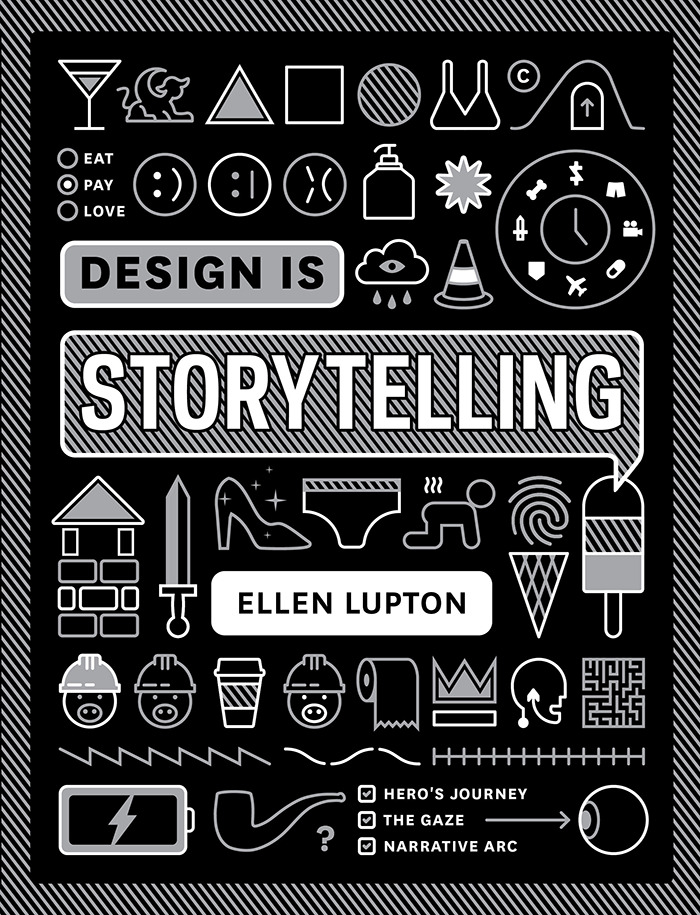
"The purpose of a storyboard is to explain action with a concise series of pictures." -- Ellen Lupton, Design Is Storytelling, Act 1: Action, p. 34
"Stories thrive on obstacles, delays, and moments of revelation. A story is a winding path, not a straight and efficient line." -- Ellen Lupton, Design Is Storytelling, Act 1: Action, p. 36
"In a satisfying narrative, the main action is significant or noteworthy, yielding a transformation or shift in the world of the story." -- Ellen Lupton, Design Is Storytelling, Act 1: Action, p. 36
"Storytelling is the most effective tool to make audiences enjoy a presentation, make them patient and curious to accept an idea, help them better understand an instruction, and keep them awake in lectures." -- Mengyan Li, quoted in Design Is Storytelling, Act 1: Action, p. 38
Rules of Thumb
- Six-frame test: If you cannot tell your design's story in six frames, you have not identified the essential beats yet.
- Ingredient audit: After drafting a storyboard, check each of the five ingredients. A missing ingredient points to a specific structural weakness.
- Active protagonist check: Ask "Does the user make a meaningful choice?" If the system does everything automatically, the experience may lack engagement.
- Emotional layer: After mapping functional steps, add a second pass for emotional states. What does the user feel at each frame?
- Branching variants: When stuck, sketch multiple endings for the same opening (as the chicken example does). Comparing outcomes reveals which ingredients are present or absent.
- Causal not sequential: Each frame should cause the next. If frames can be reordered without losing meaning, the storyboard lacks causal structure.
Related References
- Narrative Arc and Freytag's Pyramid - the arc that storyboards visualize
- Implementation Playbook - storyboard process steps