Key Principle
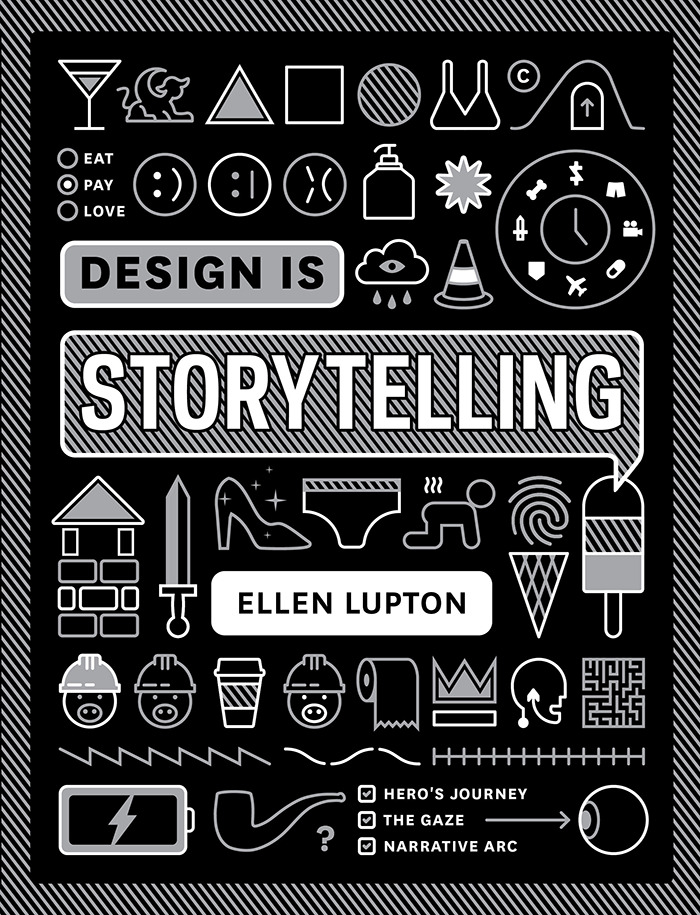
Design is not merely problem solving -- it is storytelling. Ellen Lupton organizes the entire discipline around a three-act structure that mirrors the causal chain of a user's encounter with any designed experience:
- Act 1 | Action (p. 14) -- Narrative mechanics: how the experience is structured over time. Covers narrative arc (Freytag's Pyramid), Hero's Journey, storyboarding, Rule of Threes, scenario planning, and design fiction.
- Act 2 | Emotion (p. 56) -- Affective response: how the experience makes people feel. Covers the Experience Economy, emotional journey mapping, co-creation, personas, emoji, and color as emotional lever.
- Act 3 | Sensation (p. 112) -- Perception and cognition: how the senses and cognitive biases shape interpretation. Covers the gaze, Gestalt principles, affordance, behavioral economics, and multisensory design.
The sequence is causal, not arbitrary. Emotional resonance fails without coherent structure, and sensory design misfires without emotional intent. Each layer depends on the one before it.
The cognitive engine underneath all three acts is pattern-making: humans actively seek and create patterns, and feel intrigued or frustrated when patterns break. Narrative arcs work in design not by metaphor but because they exploit the same pattern-recognition systems humans use for all perception and sense-making.
Why This Matters
Designers who skip straight to sensation (visual polish, sensory novelty) produce experiences that look good but feel hollow -- no arc, no peaks, no resolution.
Designers who skip emotion produce functionally sound objects that users don't remember or care about. The design is technically correct but emotionally inert.
Designers who treat storytelling as decoration bolt a story onto a finished product. Designers who understand this causal chain sequence the design process itself: structure first, then emotional calibration, then sensory refinement.
Without the narrative lens, designed experiences become flat: uniform intensity, no sense of progression, and no room for the user to become an active participant rather than a passive consumer.
Good Examples
NYC Subway Signage (Vignelli & Noorda, 1970) -- The signs didn't just solve the wayfinding problem across deteriorating stations; they "celebrated the subway's transition from a collection of competing subway lines to a government-owned public authority" and "conveyed values about order, reliability, and civic life." A single design artifact operating on two channels simultaneously: functional (solve the problem) and narrative (carry meaning). (Overture: Inciting Incidents)
NYC Condom Packaging (Yves Behar, 2008) -- Repurposed the same colored-dot visual language from subway signage for public health storytelling, proving the narrative channel transfers across contexts when the visual system carries cultural meaning. (Overture: Inciting Incidents)
Under Armour Registration Page -- The CEO stopped a copywriter for using "participate" instead of "compete" on a registration page. One word violated the brand's narrative of athletic intensity. Every word in design copy carries connotations that position the user relationship. (Aftermath, p. 154)
Counterpoints
- The designer does not deliver a story -- the designer shapes conditions (pacing, sensory intensity, points of rest) from which each user constructs their own narrative through a unique path. A professional designer and a third-grader will have entirely different stories from the same museum exhibition. Users are co-authors, not passive recipients.
- The three acts are not strictly sequential stages but three lenses on the same phenomenon. The same rising-and-falling shape (Freytag's arc) appears at structural, emotional, and perceptual levels. Color, for instance, operates across all three acts: narrative mood-setter in storyboards, emotional lever with biological grounding (melanopsin), and cross-modal sensory dominant that overrides taste and smell.
- A complication threads through all three acts: users take their own paths regardless of design intent, and perception is active. The designer cannot fully control outcomes.
Key Quotes
"Design is no longer focused on static objects and images. Design is a time-based, interactive enterprise." -- Ellen Lupton (Overture: Acknowledgments)
"Human beings actively seek and create patterns as we navigate the world -- and we feel intrigued, stimulated, and sometimes frustrated when patterns break." -- Ellen Lupton (Overture: Inciting Incidents)
"The signs didn't just solve a problem; they embodied ideas and principles." -- Ellen Lupton (Overture: Inciting Incidents)
"Every sentence tells a story. Every sentence has a hero and an action. A sentence can sizzle with suspense or wilt with fatigue." -- Ellen Lupton (Aftermath, p. 154)
Rules of Thumb
- Map every designed experience to Freytag's arc: exposition, rising action, crisis, climax, denouement. Without this shape, the experience feels flat.
- Design for the peak and the end (Kahneman's peak-end rule). The most intense moment and the conclusion determine how the experience is remembered.
- Use the Storytelling Checklist before shipping -- evaluate against all three acts: Action (does it depict change? is there a call to action?), Emotion (what emotions at what points? where are pain points and rewards?), Sensation (are Gestalt principles used? are non-visual senses engaged?).
- Design operates on two channels simultaneously: functional and narrative. Optimizing only for function produces artifacts that work but don't resonate.
- Distinguish productive friction (builds anticipation, conveys quality) from destructive friction (breaks the story). Not all UX obstacles are failures -- some are where the drama lives.
- Apply the Rule of Threes: two items set a pattern, the third breaks or completes it.
- When writing design copy: be concrete, use active voice, use strong verbs that embed character and stakes, show don't tell, avoid nominalizations, cut filler.
Related References
- Narrative Arc and Freytag's Pyramid - structural mechanics of Act 1
- Emotion as Design Material - emotional design of Act 2
- The Gaze and Gestalt Principles - perceptual mechanics of Act 3