Key Principle
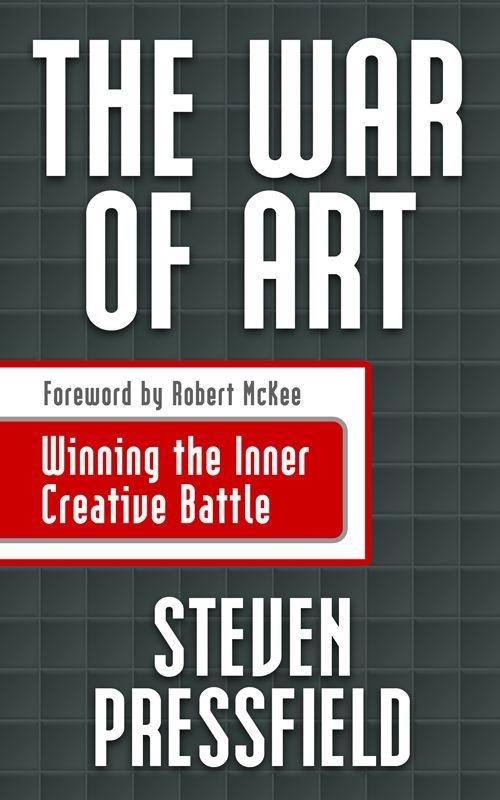
These are the operational rules distilled from across all three books of The War of Art. Each is a portable heuristic -- actionable without rereading, organized by the situation in which you need it.
Diagnosing Resistance
- The growth test. If the avoided act rejects immediate gratification in favor of long-term growth, Resistance is the likely cause of the avoidance. (Book One, "Resistance's Greatest Hits")
- Fear as compass. The project generating the most fear is the one that matters most. "The more fear we feel about a specific enterprise, the more certain we can be that that enterprise is important to us and to the growth of our soul." (Book One, Section 39)
- Love proportionality. Massive Resistance signals massive love. Indifference, not fear, is the true enemy. "The opposite of love isn't hate; it's indifference." (Book One, Section 40)
- The hollowness diagnostic. After any impulsive gratification that interrupted work, measure the emptiness. Greater hollowness means the motivation was Resistance-driven substitution, not genuine need. (Book One, "Resistance and Sex")
- Self-doubt as aspiration indicator. Self-doubt confirms authentic engagement. Its absence in a new domain is a warning sign, not a strength. "The counterfeit innovator is wildly self-confident. The real one is scared to death." (Book One, Section 38)
- The criticism signal. If you regularly criticize others, investigate whether you are avoiding your own work. "Individuals who are realized in their own lives almost never criticize others." (Book One, Section 37)
- The finish-line rule. Resistance is most powerful near completion. Any surge of doubt or urge to abandon near the end is confirmation the work is about to succeed, not evidence it is flawed. (Book One, "Resistance Is Most Powerful at the Finish Line")
- The somatic override. When the mind's rationalizations and the body's distress conflict, trust the body. If you feel physically miserable not working, that misery is the body reporting that Resistance is winning. (Book One, Section 34)
- The unhappiness ladder. Low-grade misery, boredom, and restlessness that feel like "just life" may be Stage 1 of Resistance. "Sounds like life, I know. It isn't. It's Resistance." (Book One, Section 35)
Daily Practice
- Show up regardless. Discipline causes inspiration, not the reverse. "I write only when inspiration strikes. Fortunately it strikes every morning at nine o'clock sharp." -- Somerset Maugham (Book Two, Section 52)
- The daily reset. Resistance resets to full strength every morning. Yesterday's discipline earns no credit today. "The battle must be fought anew every day." (Book One, Section 20)
- Never negotiate. Treat Resistance like a telemarketer: any engagement means you lose. "The pro doesn't even pick up the phone." (Book Two, Section 61)
- No compounding capitulation. Yielding to one plausible excuse makes yielding twice as likely tomorrow. Refuse all excuses uniformly. (Book Two, Section 61)
- Temporal collapse. Resistance operates only through temporal displacement -- "tomorrow" and "I should have." It has no purchase on the present moment of doing. Act now. (Book One, "Resistance and Procrastination")
- Priority over urgency. "You must know the difference between what is urgent and what is important, and you must do what's important first." (Book Two, Section 53)
- Invoke before working. Begin each session by requesting help from a source larger than yourself. Ask for sustenance, not brilliance. This is not ceremony; it is ego-effacement that clears the channel. (Book Three, Sections 81-84)
Mindset & Identity
- You are not your instrument. Separate identity (consciousness and will) from instrument (body, talent, results). Criticism hits the instrument; the self observes, assesses, and adjusts. (Book Two, Section 67)
- You, Inc. Think of yourself as a corporation to create emotional insulation from both failure and success. The artist does the work; the manager runs the show. (Book Two, Section 74)
- Do not heal first, create first. The creative Self is "soundproof, waterproof, and bulletproof." Work is the healing it supposedly requires. The sequence is work then healing, never healing then work. (Book One, Section 44)
- External support is Monopoly money. Encouragement and workshops cannot substitute for internal conviction. "It's not legal tender in that sphere where we have to do our work." (Book One, Section 45)
- Misery is terrain, not a stop signal. The ability to endure sustained discomfort without quitting is a learnable skill, not a character trait. Pain is the universal entry fee, not a personalized warning. (Book Two, Section 54)
- Resistance is a bully. It has no independent strength. "Its power derives entirely from our fear of it. A bully will back down before the runtiest twerp who stands his ground." (Book Two, Section 75)
- Turning pro requires no prerequisites. "There's no mystery to turning pro. It's a decision brought about by an act of will." Any claim of not being ready is Resistance in disguise. (Book Two, Section 76)
- The master fear is success, not failure. The deepest terror is that you will become who you truly are and have to leave the tribe behind. Surface fears are decoys. (Book One, Section 91)
Orientation & Territory
- The last-person-on-earth test. Would you still do this work if no one would ever see it? If yes, the orientation is territorial. If no, it is hierarchical. (Book Three, Section 99)
- The anxiety test. When anxious, do you seek reassurance from others or go do the work? The former is hierarchical; the latter is territorial. (Book Three, Section 99)
- The five properties of a territory. It provides sustenance, sustains without external input, can only be claimed alone, can only be claimed by work, and returns exactly what you put in. If any property fails, the orientation is hierarchical. (Book Three, Section 97)
- Hackwork is fear in a business suit. The hack second-guesses the audience not from strategic savvy but from fear of authentic self-expression. Even commercial success from hackwork is a loss. (Book Three, Section 96)
- Contempt for failure is a byproduct, not a posture. You cannot will yourself into it. Deepen territorial engagement until contempt for failure emerges naturally from the fact that sustenance comes from the work itself. (Book Three, Section 100)
- Work as offering. The highest orientation: do the work territorially, then surrender it to its source. Hierarchy feeds Ego; territory starves it of external validation; devotion removes even self-as-endpoint. (Book Three, "The Fruits of Our Labor")
- Creative work is moral obligation. "If you were meant to cure cancer or write a symphony... and you don't do it, you not only hurt yourself, even destroy yourself. You hurt your children. You hurt me. You hurt the planet." (Book Three, "The Artist's Life")
Key Quotes
"Most of us have two lives. The life we live, and the unlived life within us. Between the two stands Resistance." -- Steven Pressfield, Prologue
"Like a magnetized needle floating on a surface of oil, Resistance will unfailingly point to true North -- meaning that calling or action it most wants to stop us from doing." -- Steven Pressfield, Book One, Section 18
"It's not the writing part that's hard. What's hard is sitting down to write." -- Steven Pressfield, Prologue
"When we sit down each day and do our work, power concentrates around us... we become like a magnetized rod that attracts iron filings. Ideas come. Insights accrete." -- Steven Pressfield, Foreword/Book Three
"Do it or don't do it." -- Steven Pressfield, Book Three, "The Artist's Life"
Related References
- Resistance: The Core Framework - the three-book causal architecture these rules derive from
- Resistance's Manifestations and Disguises - full catalog of Resistance's properties and manifestations
- Fear as Compass and Fuel - deep treatment of the fear-importance proportionality
- Turning Pro: The Professional Mindset - the professional mindset that operationalizes the daily practice rules
- Identity Architecture: Insulating Against Resistance - the self/instrument separation behind the mindset rules
- Territory vs. Hierarchy - full development of the orientation framework
- The Ego-Self Cosmology - the ontological source of Resistance behind these heuristics
- The Muse and Higher Forces - the allied forces activated by territorial, professional commitment