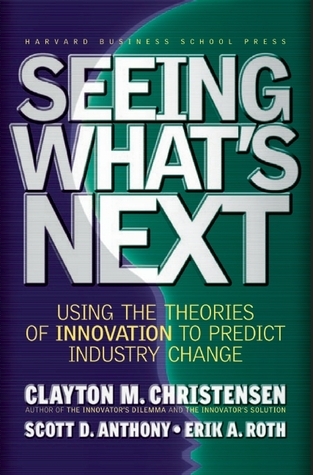
Key Principle
Theory-based analysis yields probabilistic signals, not certainties. The payoff is speed of sense-making under uncertainty: "Think of the concepts presented in this book as a road map. When the unpredictable event inevitably happens, theory can help to quickly understand the event's implications." (Conclusion)
Signals Diagnostic Rules
- Hunt for nonconsumption first. The most fertile disruption opportunity is where nobody is consuming yet -- not where competitors are fighting.
- Watch for overshooting. When customers stop paying premiums for performance improvements, the basis of competition is shifting and modular entrants gain advantage. (Ch. 7)
- Track fringe business models. Small, weird-looking ventures at the margins are the leading indicators. "Without the benefit of theory, these developments would likely be viewed as meaningless noise." (Ch. 7)
- Bet on simple delight over ambitious specs. "A simple application that delighted customers succeeded, whereas a great leap forward failed." (Ch. 10)
- Ask what job the customer hires the product to do. Segment by circumstance, not demographics.
- Monitor modularity boundaries. Where interfaces standardize, value is about to migrate.
Competitive Battle Rules
- Map the shield and sword. Entrants first grow behind asymmetric motivation (incumbents don't want to respond), then forge asymmetric skills (incumbents can't respond). Both must be present. (Ch. 2)
- Diagnose cramming immediately. When an innovation is force-fitted to customers who don't value its new attributes, failure is predictable. "Not only does an incumbent try to bring the innovation to its existing customers, it typically tries to bring it to its best existing customers. Ironically, these customers value the new attributes of the disruptive innovation the least." (Ch. 2)
- Sustaining entrants lose. Entrants pursuing sustaining innovations should partner with or sell to incumbents, not compete head-on. "An entrant has a much higher likelihood of success if it defines success as working with an incumbent." (Conclusion)
- Process excellence is process inflexibility. "A good process is by definition inflexible -- it is designed to do the same task well, over and over again." (Ch. 2) This is why incumbents cannot simply retool.
- Beware overestimating disruption. "Look at the co-optability of the innovation and the motivation of incumbents to fight the disruption rather than to flee it." (Conclusion) Networked industries give incumbents unusual co-option power.
- Track the flee-up pattern. If an incumbent is ceding low-end segments to move upmarket, ask: is there an "up" left to sustain that retreat? (Ch. 2)
Strategic Choice Rules
- Use emergent strategy in uncertainty. Discovery-driven planning beats deliberate strategy when the winning formula is unknown. Switch to deliberate only after finding product-market fit. (Ch. 3)
- Demand patient-for-growth, impatient-for-profit capital. Wrong investor values kill disruptive ventures by demanding scale before the business model is proven. (Ch. 3)
- Build in freestanding value networks. Overlapping networks give incumbents natural co-option points. Independence preserves disruptive potential. (Ch. 3)
- Staff for learning, not credentials. Schools-of-experience hiring -- selecting managers who have navigated relevant uncertainties -- matters more than pedigree. (Ch. 3)
- Entrants must stay disciplined. "Entrants bent on disruption must avoid fighting battles they cannot hope to win -- trying to stretch underperforming products to reach large markets populated by very demanding customers." (Ch. 7)
Cross-Industry Patterns
- Conservation of integration recurs everywhere. When one value chain layer commoditizes, the adjacent layer integrates and captures profits -- fabs, routers, health care delivery. (Ch. 1, 7, 10)
- Cramming is the universal failure mode. The same mistake appears across airlines, Intel, 3G operators, and education technology. (Ch. 2, 6, 7, 10)
- Disruption is a process, not an event. "No industry transforms overnight; watch for trajectories and accumulating asymmetries, not for dramatic single events." (Conclusion)
- Disruption is relative. The same innovation can be disruptive to one firm and sustaining to another. Labeling an innovation "disruptive" without specifying to whom guarantees misprediction. (Conclusion)
- Nonmarket forces are wild cards. Government regulation can shift entire industries between motivation/ability quadrants. Analyze them separately. (Ch. 4)
Five Practitioner Rules (from the Conclusion)
- Challenge "unassailable" data. It describes only the past. Past success does not predict future success. (Conclusion)
- Use theory to guide data collection. Theory and data are complements: "Trust. But verify." (Conclusion)
- Everything is relative. Evaluate each innovation through each firm's specific strengths, weaknesses, and mental models. (Conclusion)
- Distinguish announcements from actions. "Companies often use press releases to create noise, but noise does not drive industry change." (Conclusion)
- Choices matter, up to a point. "Early decisions can greatly influence a firm's capabilities, which define its disabilities, which determine what strategic options will ultimately prove unpalatable." (Conclusion)
Common Mistakes to Avoid
- Treating theory as fortune-telling. "An entering firm can do everything right but still get crushed by an incumbent firm that takes the right countervailing options." (Introduction)
- Demanding binary answers from signals. "A signal should not be confused with conclusive evidence." (Introduction)
- Cramming disruptive innovations into large markets. "Attempts to cram a disruptive innovation into a large existing market almost never work. Customers tend to reject the innovation." (Conclusion)
- Assuming incumbents always lose. In networked industries with high interdependence, incumbents have structural avenues to absorb disruptions. (Ch. 10)
- Confusing resources with capabilities. Noda and Bower (1996) showed firms with similar resources produced divergent outcomes due to different processes and values. (Ch. 2)
- Mindlessly extrapolating past trajectories. "Companies mindlessly pursuing Moore's Law should not be mindlessly expected to triumph." (Ch. 7)
Why This Matters
These 27 rules compress the book's seven theories into a diagnostic checklist. Applied together -- signals tell you where to look, battles tell you who wins, choices tell you whether management will execute -- they form a repeatable method for interpreting industry change faster than competitors.
Related References
- Core Framework -- the three-step analytical process in detail
- Competitive Battles -- shield/sword and RPV deep dive
- Strategic Choices -- emergent strategy, value networks, preparation regimen
- Value Chain Evolution -- conservation of integration mechanics
- Implementation Playbook -- applying these rules in practice