Entrepreneurship
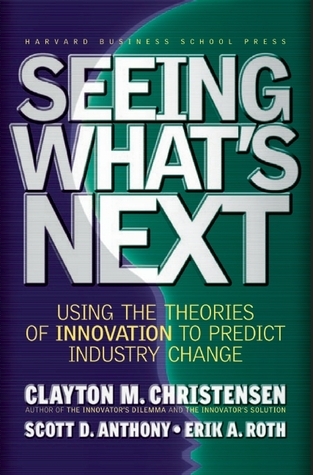
Seeing What's Next: Using the Theories of Innovation to Predict Industry Change
Clayton M. Christensen, Scott D. Anthony, Erik A. Roth 2004 15 references
Apply Christensen's disruption theory as a predictive toolkit to analyze industry change, assess competitive battles, and evaluate strategic choices.
disruption innovation competitive-strategy prediction industry-analysis value-chain
Overview
The Core Framework
- Three theories power prediction: Disruptive Innovation (new-market vs low-end), RPV (Resources/Processes/Values), and Value Chain Evolution (integration ↔ modularity cycles)
- Three-step diagnostic: (1) Identify signals of change via customer tiers, (2) Evaluate competitive battles via asymmetries, (3) Assess strategic choices that raise or lower odds
- Disruption is a process, not an event — no industry transforms overnight; watch for fringe developments improving over years
- Simple beats sophisticated — across every industry studied, simple products targeting nonconsumers outperform ambitious technology pushes
- Values, not resources, explain incumbent failure — the resource-allocation process systematically deprioritizes disruptive opportunities
Quick Lookup
| Situation | Do This | Avoid This |
|---|---|---|
| Evaluating a new entrant | Check for nonconsumption targeting + asymmetric motivation | Assuming cheaper = disruptive |
| Assessing incumbent response | Run RPV tale-of-the-tape (values filter is key) | Resource-only competitive analysis |
| Choosing strategy for uncertain market | Use emergent strategy + discovery-driven planning | Deliberate strategy with untested assumptions |
| Evaluating funding sources | Seek patient-for-growth, impatient-for-profit capital | Growth-before-profit investor pressure |
| Predicting industry structure shifts | Check for overshooting → modularity → specialist entry | Assuming integration disappears |
| Analyzing regulation impact | Apply motivation/ability 2x2 matrix | Treating regulation as purely blocking |
The Key Insight
"There is an important difference between a signal — an imperfect indicator of the future based on current data viewed through the lens of a theory — and evidence that more conclusively demonstrates that a predicted event has come to pass." — Christensen, Anthony, Roth, Introduction
References
No references match your search.