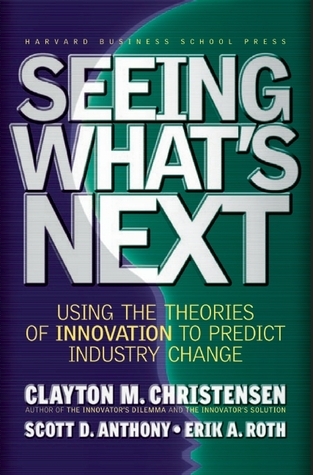
Key Principle
The book's core analytical scaffold is a three-part process for converting innovation theory into forward-looking industry predictions: (1) identify signals of change, (2) evaluate competitive battles, and (3) assess strategic choices. Each step feeds the next. Signals identify where disruption may be forming; competitive-battle analysis predicts who wins once contact occurs; strategic-choice analysis reveals whether firms are strengthening or undermining their own positions.
The engine powering this process is theory, not data. A useful theory has two components: a circumstance-based categorization scheme and a causal statement linking actions to results within each circumstance. The analyst's job is to diagnose what type of situation this is rather than guess what will happen -- converting prediction from impossible to tractable.
Why This Matters
Conclusive data only exists about the past. Historical pattern-matching fails for novel innovations because there is no precedent to match against. Western Union dismissed Bell's telephone as a "toy" in 1876; AT&T's mobile phone testing in 1978 concluded the market was trivial; analysts misjudged 802.11 wireless networks in 2004. In each case, data-driven analysis failed because the innovation created a category that did not yet exist in the historical record.
The barrier to applying disruption theory was never understanding the concepts -- it was procedural. Prior readers of Christensen's work "didn't know the questions to ask to determine unambiguously before the fact whether an innovation would have a sustaining or disruptive impact on their industry" (Introduction). This three-step process closes that gap by providing a repeatable diagnostic method: where to look, what to look for, and which questions to ask. The telecom bubble of 1997-2003, which destroyed roughly $2 trillion in market value, illustrates how theory could have predicted which technologies had an exciting future even as hype collapsed around them.
Good Examples
Incumbent co-option of wireless: Telecom incumbents absorbed wireless technology rather than being disrupted by it. They possessed the resources to build networks, had compatible processes, and held values that motivated pursuing wireless as growth. Separate divisions shielded them from the innovator's dilemma. A truly disruptive wireless path would have targeted nonconsumers -- "parents who wanted to keep in touch with their children within a local neighborhood" -- and built networks deliberately designed to not interact with the existing telephone network. Because incumbents co-opted wireless before this path matured, the disruptive threat was neutralized. (Introduction)
Microsoft vs. Linux: Microsoft had 50,000+ employees, billions in cash, and dominant brands. The failure was not a resource problem. Its values made it "very difficult for Microsoft to prioritize a Linux-based business compared to the other investment opportunities that promise profits that are more attractive" (Introduction). The RPV lens -- the second theory feeding the analytical process -- diagnoses this as rational neglect, not managerial incompetence.
Low-end disruption pattern: Nucor minimills, Wal-Mart discount retail, Vanguard index funds, and Dell direct-to-customer each exploited the overshoot gap where companies improved products faster than customer needs evolved. Incumbents dismissed these entrants because the customers being taken were the least profitable ones -- rational neglect that compounded over time. (Introduction)
Counterpoints
Data-driven prediction fails for novel categories: Western Union, AT&T mobile testing, and early wireless assessments all demonstrate that when no historical pattern exists for the innovation in question, even the most rigorous quantitative analysis produces wrong answers. The analytical process demands theory-first reasoning precisely because data cannot speak to what has not yet happened.
Theory yields signals, not certainties: The framework operates on probabilistic indicators, not binary proof. "A signal should not be confused with conclusive evidence. A signal means that there is a chance an industry is in a particular circumstance" (Introduction, Note 9). Readers who demand definitive answers will misapply the framework. An entering firm "can do everything right but still get crushed by an incumbent firm that takes the right countervailing options" (Introduction).
Porter's five forces describes but does not predict: Industries that appear permanently broken -- aviation's dismal economics, health care's spiraling costs -- may actually be signaling that disruptive innovation conditions are forming. Five forces can explain current structure but not future disruption. That requires the disruption theory lens, which reads apparent industry failure as the precondition for disruptive entry. (Introduction)
Key Quotes
"The only way to look into the future is to use these sorts of theories, because conclusive data is only available about the past." (Introduction)
"Good management theory provides situation-specific statements of cause and effect." (Introduction)
"If you know where to look and what to look for, you can spot industry-changing firms before they emerge." (Introduction)
"We know the forces that act on every firm. With high probability, we can predict how managers will react to those forces. We do believe, however, that managers who understand the forces can account for them and behave differently." (Introduction)
Rules of Thumb
Categorize before you predict. Ask "what type of situation is this?" -- sustaining, low-end disruptive, or new-market disruptive -- before attempting to forecast outcomes. The classification determines which causal mechanism applies.
Follow the asymmetry. Incumbents almost always win sustaining contests; entrants almost always win disruptive ones. If you can classify the contest type, you can predict the likely winner.
Watch the overshoot gap. When company improvement trajectories outpace customer demand trajectories, overserved customers accumulate. This divergence -- not any single product decision -- is the structural precondition for disruption.
Treat signals as probabilistic, not binary. Accumulating consistent signals raises confidence but never reaches certainty. The goal is to "dramatically increase the odds of getting things right," not to achieve proof.
Check for nonconsumption. New-market disruption competes against people who lacked the expertise or wealth to participate. If an innovation is creating customers who did not previously exist, the disruptive path is new-market, not low-end.
Test for incumbent co-option. Disruption is not inevitable. Incumbents can neutralize disruptive threats through separate divisions, resource deployment, and adapted processes. Always ask whether the incumbent has the motivation and the organizational structure to respond.
Related References
- Disruptive Innovation Theory - The first theory feeding the analytical process
- RPV Theory — Resources, Processes, Values - The second theory for competitive assessment
- Value Chain Evolution & Conservation of Integration - The third theory for industry structure prediction