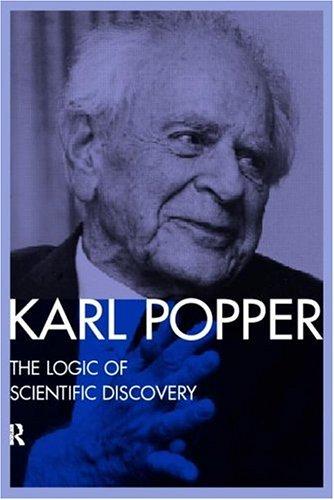
Key Principle
Science proceeds not by induction (generalizing from observations) but by deductive testing: proposing bold theories, deriving testable predictions, and attempting to refute them. The criterion that separates empirical science from non-science is falsifiability — the logical possibility of contradiction by observation — not verifiability or meaningfulness.
This rests on a single logical asymmetry: universal statements ("All swans are white") can never be derived from singular statements, but they can be contradicted by them via modus tollens. If theory T entails prediction P, and P is observed to be false, then T is false. This is "the only strictly deductive kind of inference that proceeds... in the 'inductive direction'" (Chapter 1).
Why This Matters
The problem of induction — how to justify the leap from finite observations to universal laws — is not merely difficult but logically insoluble. No number of white swan sightings justifies "All swans are white." The traditional response was to seek weaker justification: theories become "probable" rather than "certain." But Popper shows this retreat fails too (see The Formal Probability Calculus and Zero-Probability Proof): universal laws have zero probability in any infinite universe.
Without falsifiability as an alternative criterion, we face a dilemma: either we cannot distinguish science from metaphysics (the demarcation problem), or we use verifiability — which destroys science along with metaphysics, since universal laws are no more reducible to observations than metaphysical claims.
Good Examples
Einstein vs. Newton: Einstein's general relativity made a bold, precise prediction about the bending of starlight during a solar eclipse. The 1919 Eddington expedition could have refuted the theory. This is paradigmatic deductive testing: derive a risky consequence and attempt to observe its failure (Chapter 1).
Modus tollens in action: "If all swans are white, then any swan observed in Australia will be white. A black swan is observed in Australia. Therefore, not all swans are white." The universal law is destroyed by a single counterinstance — this is the asymmetry at work (Chapter 1).
Popper's four lines of testing: (1) Compare conclusions among themselves for internal consistency, (2) investigate the logical form to determine whether the theory is empirical or tautological, (3) compare it with other theories to see if it would constitute an advance, (4) test it by deriving empirical predictions and comparing them with experience (Chapter 1).
Counterpoints
Psychologism: Some argue that the origin of a theory matters — how the scientist arrived at the idea. Popper insists only the testing matters: "the question of how it happens that a new idea occurs to a man... may be of great interest to empirical psychology; but it is irrelevant to the logical analysis of scientific knowledge" (Chapter 1). Einstein agreed: universal laws "can only be reached by intuition."
Verificationism: The Vienna Circle proposed that meaningful statements must be empirically verifiable. But this criterion "is not only metaphysics which is annihilated by these methods, but natural science as well. For the laws of nature are no more reducible to observation statements than metaphysical utterances" (Appendix *i).
Naive falsificationism: Falsifiability as a logical criterion is necessary but insufficient. Without methodological rules preventing ad hoc immunization, any theory can evade refutation (see Conventionalist Stratagems and Methodological Rules).
Key Quotes
"No matter how many instances of white swans we may have observed, this does not justify the conclusion that all swans are white." — Karl Popper, Chapter 1
"In so far as a scientific statement speaks about reality, it must be falsifiable: and in so far as it is not falsifiable, it does not speak about reality." — Karl Popper, Appendix *i
"I equate the rational attitude and the critical attitude." — Karl Popper, Preface (1959)
Rules of Thumb
- Ask of any theory: "What observation would refute this?" If no answer exists, the theory is metaphysical
- Judge theories by what they forbid, not by what they permit
- Never confuse the origin of a theory with its scientific standing — only testability matters
- Prefer theories that make precise, risky predictions over those that accommodate any outcome
Related References
- Conventionalist Stratagems and Methodological Rules — Why falsifiability needs methodological rules to work
- Content, Testability, and Degrees of Falsifiability — The quantitative backbone: more content = more testability
- Critique of Positivism and the Vienna Circle — Why verifiability fails as an alternative criterion