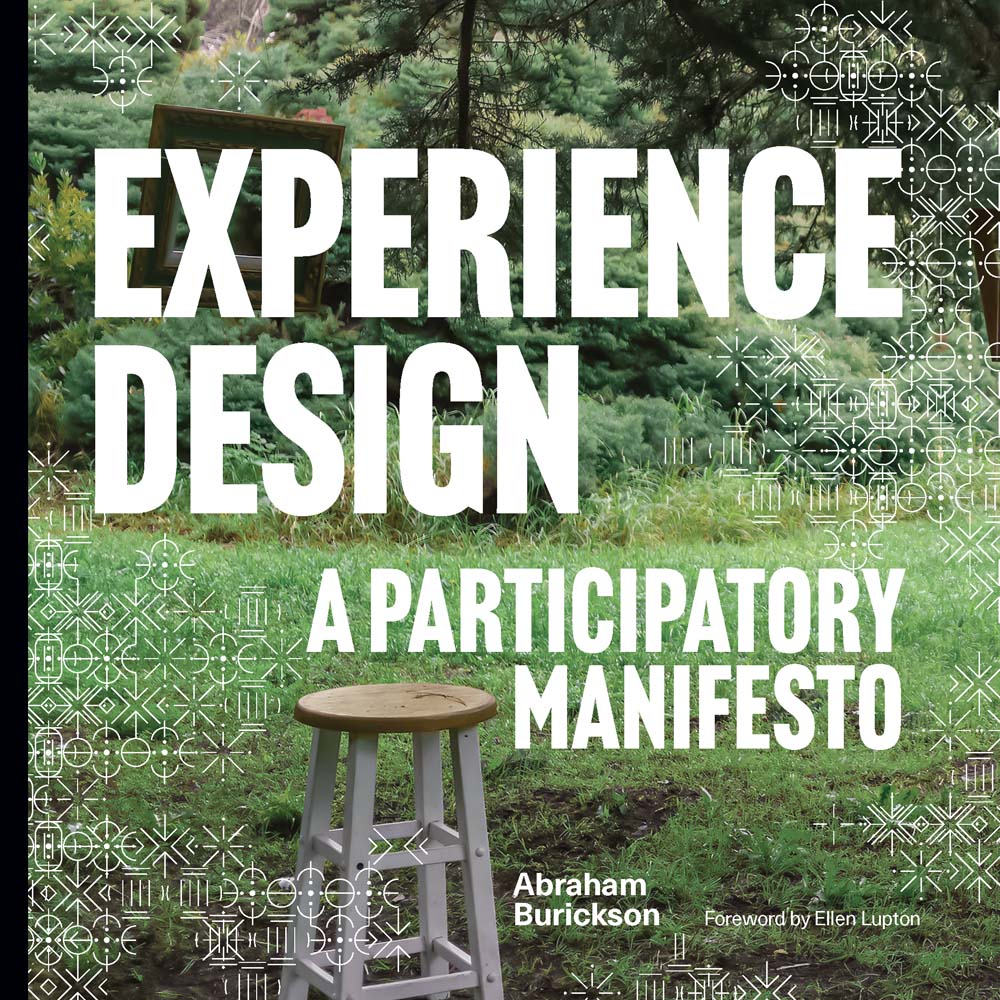
Narrative Is Everywhere
Key Principle
Narrative is not a story you make — it is the meaning-making medium humans already inhabit. A story is a bounded object (a book, a film, a script). Narrative is unbounded connective tissue: "the innate human activity of making significant connections among events, people, things, ideas" (p. 101). It is experienced as "words, but also as colors, sounds, smells, sensations, intuitions, dream connections" (p. 101). Designers who conflate story with narrative produce artifacts instead of experiences.
The Human Story Spectrum maps narrative registers by frequency, analogous to the electromagnetic spectrum. At the high-frequency end sits ultrastory — stories so small they escape notice: a breath, a name, a gesture. These "charge the hours and minutes of our days with meaning" (p. 104). At the low-frequency end sits infrastory — stories so large they escape notice: identity, history, God, America, Life. Between them lies the visible story spectrum, what we conventionally call stories: poems, articles, novels. "A good story shines brightly at its spot on the spectrum. A great narrative experience lights up spots all across the spectrum" (p. 104).
Four types of interactive narrative distribute authorial control across this spectrum:
- World-Narrative (Being): Nonlinear exploration where the audience is the protagonist. The designer orients; the audience authors. Examples: Sleep No More, Disneyland, tourism (pp. 111-112).
- Prescribed Linear (Becoming): Fixed path, highest designer control. Bodily participation makes ancient stories personally owned. When the experience changes what someone is called — Hajji, PhD, married name — narrative has permanently redefined identity (pp. 112-113).
- Branching Narrative (Discovery): Choose-your-own-adventure structures that foreground the experience of choice. Meg Jayanth wrote 500,000+ words for 80 Days — over 7x what any single player encounters (p. 114).
- Cocreated Narrative: Structured improvisation where participants listen, offer, and build forward. Success depends on empathic attunement and the aptness of underlying structure (p. 116).
Why This Matters
Without the narrative lens, designers optimize the object and declare the work done. But "every story is an interface between the story being told and the broader narrative it connects to within the lives of its audience" (p. 102). The object is "static and discrete"; the experience is "dynamic and connected and personal for each reader" (p. 102). Ignoring the audience's existing narrative ecology means the experience lands flat, feels generic, and fails to resonate personally.
The aboutness gap makes this concrete: a story about grief does not guarantee the audience experiences grief. Content and felt experience diverge (p. 118). Designers who confuse subject matter with experiential outcome produce work that is thematically correct but emotionally inert. The design problem is never "What is this story about?" but "What narrative experience does the audience walk away with?"
Narrative also stacks in layers — each layer invokes and is comprehended by another. The visible story affects the invisible story, and vice versa. You cannot control which layer surfaces for a given audience member, so design must account for the nexus of stories the audience already carries (p. 118).
Good Examples
Jay-Z's Decoded (Droga5, 2010): Book text placed at real-world locations — Marcy Houses, bus stops, burger wrappers, pool bottoms. The project was "not a new story but an intervention in the story you already had about Jay-Z, and maybe in the story you had about yourself" (p. 102). Narrative as property of place, not just text.
Jewish Museum Berlin (Libeskind): Three axes — Exile, Holocaust, Continuity — narrate through walking, not exhibits. Sparse programming forces the body to carry the story. Educational text operates above; embodied architectural narrative below. The layers work independently on visitors, proving that spatial sequence plus emptiness can do the work of text (pp. 106-107, 118).
Sleep No More (Punchdrunk): The source material (Macbeth) matters less than each masked audience member's personal narrative of exploration and discovery. "One must never confuse the written story with the experienced story" (p. 109). The audience is "the most important character in their own story" (p. 111).
Passover Seder: Prescribed linear narrative where multisensory participation — eating ritual foods, reclining, reciting — makes an ancient story of liberation feel personally owned. "When the event is successful, participants feel it is their story, that the metaphors of slavery and freedom are relevant to their lives" (p. 112).
Counterpoints
Narrative omnipresence does not mean every design needs a plot. It means every design already has narrative consequences whether the designer attends to them or not. "Just as there is no such thing as no temperature, there is no such thing as no narrative; it is a property of experience" (p. 118). The question is not whether to use narrative but which registers and interactive modes serve the intended experience.
The written story and the experienced story always diverge. "We can no more hope to fully determine the narrative experience our audience walks away with than a parent can hope to fully determine the personality of their child" (p. 118). Designing for both the experiencing self (sustained texture, presence) and the remembering self (peak moments, memory) is the frontier — most designs serve only one (p. 109).
Cocreated narratives require structure, not formlessness. Without an underlying scaffold — the conventions of a conversation, an improv format, a ritual sequence — cocreation collapses into aimlessness. The designer's role shifts from architect to facilitator, but facilitation demands deliberate structural choices (p. 116).
Key Quotes
- "Narrative is the water in which we swim, so ever-present that we cannot see it." (p. 101)
- "Every story is an interface between the story being told and the broader narrative it connects to within the lives of its audience." (p. 102)
- "The experience designer builds narrative across the whole spectrum." (p. 104)
- "Few frames are thicker than those that are entered by such a descent." (p. 106)
- "One must never confuse the written story with the experienced story." (p. 109)
- "Tourism is a narrative collaboration between the place and the tourist, offering visitors a way of being in a world that is more or less fictional." (p. 111)
- "Just as there is no such thing as no temperature, there is no such thing as no narrative; it is a property of experience." (p. 118)
- "The placebo effect... is evidence of the transformative power of such narratives." (p. 117)
Rules of Thumb
- Treat narrative as a mass noun, not a count noun. You are not inserting a story into an experience; you are shaping the narrative ecology the audience already inhabits.
- Design across the full spectrum. Check your work against ultrastory (micro-moments), visible story (the recognizable arc), and infrastory (identity and worldview). A great experience activates all three registers.
- Choose your interactive mode deliberately. World-narrative for being, prescribed linear for transformation, branching for discovery, cocreation for intimacy. Each fails characteristically when misapplied.
- Mind the aboutness gap. Subject matter is not experiential outcome. Ask what the audience will feel and remember, not what the content is about.
- Design for both selves. Peak moments feed the remembering self; sustained texture feeds the experiencing self. Neglecting either produces Instagram-bait or unmemorable flow.
- Respect the audience's existing narrative. The designer's actual project is "the one that happens in the audience's mind, the one that is assembled from a vast array of forms" (p. 103). Start from the stories the audience already carries.
- Match control to intent. High control demands flawless execution — any seam collapses the spell. High freedom demands strong orientation — without it, agency becomes aimlessness.
- Provide structure for cocreation. Facilitating is not the same as abdicating. Offer scaffolds — conversational structures, ritual forms, improv conventions — then step back.
Related References
- Worldbuilding: Four Elements of a World — World-narrative (Type 1) depends on worldbuilding to create the environment the audience explores and authors meaning within.
- Design for the Unknown — The aboutness gap and the written/experienced story split mean the designer never fully controls narrative outcome; designing for the unknown is the necessary posture.
- How Experiences Are Framed — Frames determine which narrative register is active; spatial descent and architectural narrative (Jewish Museum) function as frames that shift audiences into story-reception mode.