Key Principle
The central aesthetic challenge of speculative design is "successfully straddling both" real and not-real -- "to fall on either side is too easy" (Chapter 7). Too real: mistaken for an actual product, fails to provoke. Too fantastical: dismissed as pure fantasy, loses traction. The designer chooses a level of visual fidelity to control the audience's evaluative frame. This is not a stylistic preference but an operational mechanism: representational style is the primary tool for landing proposals in the zone where audiences can genuinely argue about feasibility and desirability.
Why This Matters
Speculative design's core function -- provoking debate about alternative possibilities -- depends entirely on calibrating ambiguity. "Too many visionary schemes suffer from an excess of realism that invites pragmatic critique undermining their inherent poetry and power to inspire" (Chapter 7). The failure cascades in both directions: excess realism triggers feasibility assessment that kills ideas before they provoke thought; excess abstraction crosses a threshold where the object reads as a toy, undermining seriousness.
A second failure mode is tool-driven aesthetics. CGI has evolved technologically but "not so much aesthetically" -- "the software is the voice behind the imagery" (Chapter 7). Designers who default to available rendering tools produce work whose aesthetic is determined by the medium rather than by deliberate rhetorical choice. The pastiche trap -- mimicking corporate, high-tech, or high-style design languages for credibility -- compounds this by producing confirmation rather than provocation.
Good Examples
Sottsass, Planet as Festival (1972-1973): Naive pencil drawings of fourteen symbolic cities depicting a utopian land free from work. "Their cartoonlike quality invites us to view them as inspirational daydreams rather than hard proposals intended to be realized" (Chapter 7). The drawing style is the speculative signal -- abstraction protects the ideas from pragmatic dismissal while encoding anti-consumerist politics.
Filip Dujardin, Fictions (2007): Recombines photographs of real buildings into fictional architecture that "challenge[s] us to decide for ourselves if they are real or not" (Chapter 7). Photography's implicit truth-authority means minimal intervention yields maximum speculative effect -- the medium itself does the rhetorical work.
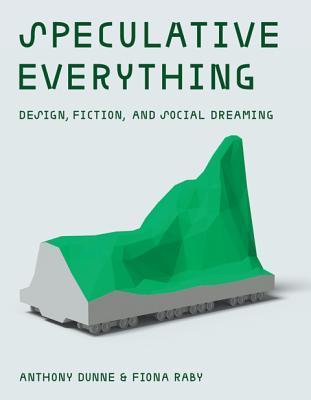
Marijn Van Der Poll, Modular Car (2002): A motorized foam block that is a fully operational car, "a striking anti-image of everything car design is today" (Chapter 7). This is prop aesthetics re-entering everyday life as functional anti-design -- by reducing a product to its functional essence, it reveals that most conventional design is "a by-product of the marketing ethos centered on utility and status" (Chapter 7).
Counterpoints
The toylike trap: Abstraction in speculative objects risks producing toylike qualities that undermine the work's seriousness. Dunne & Raby's Robots (2007) used abstract forms so "people would not fuss about functionality" but acknowledge the toylike quality is something they "strive hard to avoid" (Chapter 7). The toy-model continuum is a genuine design variable with different rhetorical effects at each position.
Film aesthetics do not transfer directly: Films work because audiences accept the rules of fiction before viewing; design objects have no such contract. "These films do the opposite of what we argue for in physical fictions. They make us believe even though we know they are not real, which works because they are films" (Chapter 7). Applying cinematic realism to speculative props "can confuse reality and fiction in unproductive ways."
Characters are more powerful than objects: When speculative scenarios include characters, they become the most rhetorically powerful element because they exploit innate social cognition. "When done well, the character not only speaks for itself but also for the values and ethics of the world it inhabits" (Chapter 7). Designers who focus only on object aesthetics miss the strongest communication channel.
Key Quotes
"How do you design for unreality, and what should it look like? ... This is where the aesthetic challenge for speculative design lies, in successfully straddling both. To fall on either side is too easy." -- Dunne & Raby, Chapter 7
"We believe it is more interesting to explore new aesthetic possibilities for speculative objects that signal their ambiguous status as simultaneously real and unreal." -- Dunne & Raby, Chapter 7
"Once you drop the future aspect of speculative work you instantly broaden the scope for aesthetic experimentation and inventive portrayal of alternative realities." -- Dunne & Raby, Chapter 7
"By moving away from the polar extremes of futurism and naturalism, a world of aesthetic and communicative possibility becomes available for speculative design." -- Dunne & Raby, Chapter 7
Rules of Thumb
- Choose visual fidelity deliberately as a rhetorical lever: sketches signal speculation, photographs carry truth-claims, detailed technical drawings create productive confusion about status
- Aim for "just enough oddness to hold our attention without being ridiculous or completely impossible" (Chapter 7) -- productive ambiguity is the sweet spot
- Watch for the pastiche trap: referencing known design languages (corporate, high-tech) produces confirmation rather than provocation
- Use the worldbuilding spectrum as a decision framework: corporate future video, tweaking the everyday, white box/blank canvas, constructed unrealities, or hidden realities -- each has known tradeoffs
- Speculation need not violate physical laws; designs can be speculative because they are economically unfeasible rather than physically impossible
- Borrow atmospheric techniques from fashion photography, experimental cinema, and fine art -- design's default realism cannot produce the strangeness speculative work requires
- Small estrangement details outperform elaborate world-construction: a single anachronistic object communicates more efficiently than a fully dressed set
Related References
- Physical Fictions and Make-Believe - The make-believe framework that these aesthetic strategies serve
- The Methodological Playground - The fictional methods that generate the content these aesthetics represent
- Dissemination and Exhibition Strategies - How aesthetic choices interact with exhibition and circulation contexts