Key Principle
Design should redirect its fiction-making capacity from commercial problem-solving toward speculation about how things could be, creating proposals that catalyze debate and social dreaming. The core act is proposing -- not solving, not predicting, not prescribing.
"The idea of the 'proposal' is at the heart of this approach to design: to propose, to suggest, to offer something." (Chapter 9)
Proposals are "closer to literature than social science, emphasize imagination over practicality, and ask questions rather than provide answers" (Chapter 9). Their value is "not what it achieves or does but what it is and how it makes people feel" (Chapter 9). They require rigorous research foundations but must not lose "imaginative, improbable, and provocative qualities" (Chapter 9).
Why This Matters
Design's default mode -- optimistic, commercial problem-solving -- is inadequate for challenges that cannot be broken down and fixed (climate change, overpopulation, technological disruption of human identity). These challenges require changing values, beliefs, attitudes, and behavior, which requires imagination, not optimization.
Without a speculative orientation, design's optimism functions as denial in two ways:
- It masks how serious the problems actually are.
- It channels energy into "fiddling with the world out there rather than the ideas and attitudes inside our heads that shape the world out there" (Chapter 1).
The deeper stakes are about imaginative possibility itself. As society moves toward monoculture, the range of thinkable alternatives contracts. Social limits are self-referential: "The actual limits of what is achievable depend in part on the beliefs people hold about what sorts of alternatives are viable" (Erik Olin Wright, cited Chapter 9). Changing beliefs about possibility changes possibility itself.
Speculation is therefore not idle dreaming but active intervention in probability space: "By speculating more, at all levels of society, and exploring alternative scenarios, reality will become more malleable and, although the future cannot be predicted, we can help set in place today factors that will increase the probability of more desirable futures happening" (Chapter 1).
Good Examples
The A/B Manifesto (Preface): Juxtaposes mainstream design values against speculative alternatives -- "user-friendliness" vs. "ethics," "makes us buy" vs. "makes us think," "consumer" vs. "citizen," "applications" vs. "implications," "fictional functions" vs. "functional fictions." The contrast makes invisible assumptions visible. Column B is not a replacement but "another dimension," deliberately incomplete to invite columns C, D, E. (Preface)
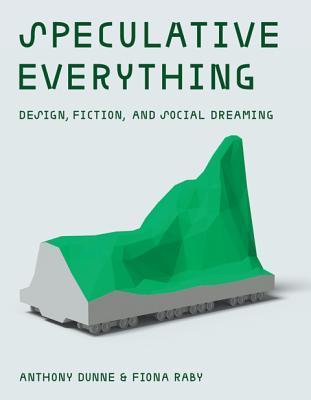
Communo-Nuclearists Train (Chapter 9): A no-growth micro-state on a nuclear-powered, 3km-long mobile train -- "voluntary prisoners of pleasure, free from the pressures of daily survival." The design embeds irreconcilable tensions (the most technologically dependent society produces the most naturalized environment) so viewers cannot passively accept or reject. Deliberately incomplete -- "designed to be suggestive, for people to wonder what might lie inside." (Chapter 9)
Universities as Speculation Platforms (Chapter 2): Designers should partner with civic organizations, and universities should serve as institutional bases for speculation, precisely because they operate outside market logic. "Universities and art schools could become platforms for experimentation, speculation, and the reimagining of everyday life." (Chapter 2)
Counterpoints
Speculation vs. prescription: Speculative design loses its function if it becomes didactic or moralistic. The designer's role is to catalyze debate, not author futures. "The days of designers dreaming on behalf of everyone have passed but designers can still facilitate a dreaming process that unlocks people's imaginations" (Chapter 9). Prescriptive work collapses speculation back into conventional design.
New orthodoxy risk: The A/B framework warns against treating speculative design as a replacement paradigm. "B was not intended to replace A but to simply add another dimension" (Preface). When critical design becomes "a design label rather than an activity, a style rather than an approach" (Chapter 3), it reproduces the ideological closure it aims to resist.
Ideological closure from two directions: Hyper-commercialization (1980s) made all non-market design seem "economically unviable and therefore irrelevant" (Chapter 1). The collapse of visible alternative social models (1989) shrank reality to "one dimensional" (Chapter 1). Both forces must be actively counteracted; they are not historical curiosities but ongoing structural pressures.
Key Quotes
"Design's inherent optimism leaves no alternative but it is becoming clear that many of the challenges we face today are unfixable and that the only way to overcome them is by changing our values, beliefs, attitudes, and behavior." -- Dunne & Raby, Chapter 1
"As we rapidly move toward a monoculture that makes imagining genuine alternatives almost impossible, we need to experiment with ways of developing new and distinctive worldviews that include different beliefs, values, ideals, hopes, and fears from today's. If our belief systems and ideas don't change, then reality won't change either." -- Dunne & Raby, Chapter 9
"Large-scale speculative design contests 'official reality'; it is a form of dissent expressed through alternative design proposals." -- Dunne & Raby, Chapter 9
"We need more pluralism in design, not of style but of ideology and values." -- Dunne & Raby, Chapter 1
Rules of Thumb
- Speculation is active intervention in probability space, not idle fantasy. Even unrealized proposals expand what feels viable.
- The success metric is not adoption or feasibility but the loosening of imaginative constraints.
- Proposals should embed contradictions and trade-offs that force viewers to do their own intellectual work, not consume a pre-packaged vision.
- Futures are a medium to speculate with, not destinations to strive for.
- Pluralism of ideology and values -- not pluralism of style -- is the prerequisite for genuine speculation.
- The present is shaped by the future (hopes, dreams) as much as by the past. Speculation is a force acting on the present.
- Even nonviable alternatives are valuable if imaginative, because they serve as inspiration for imagining one's own alternatives.
Related References
- The PPPP Futures Cone - The cone framework mapping where speculative design operates
- Critical Design as Attitude - Critical design as the attitude enabling speculative practice
- Functional Fictions and Biodesign - Applied speculative method in biotechnology