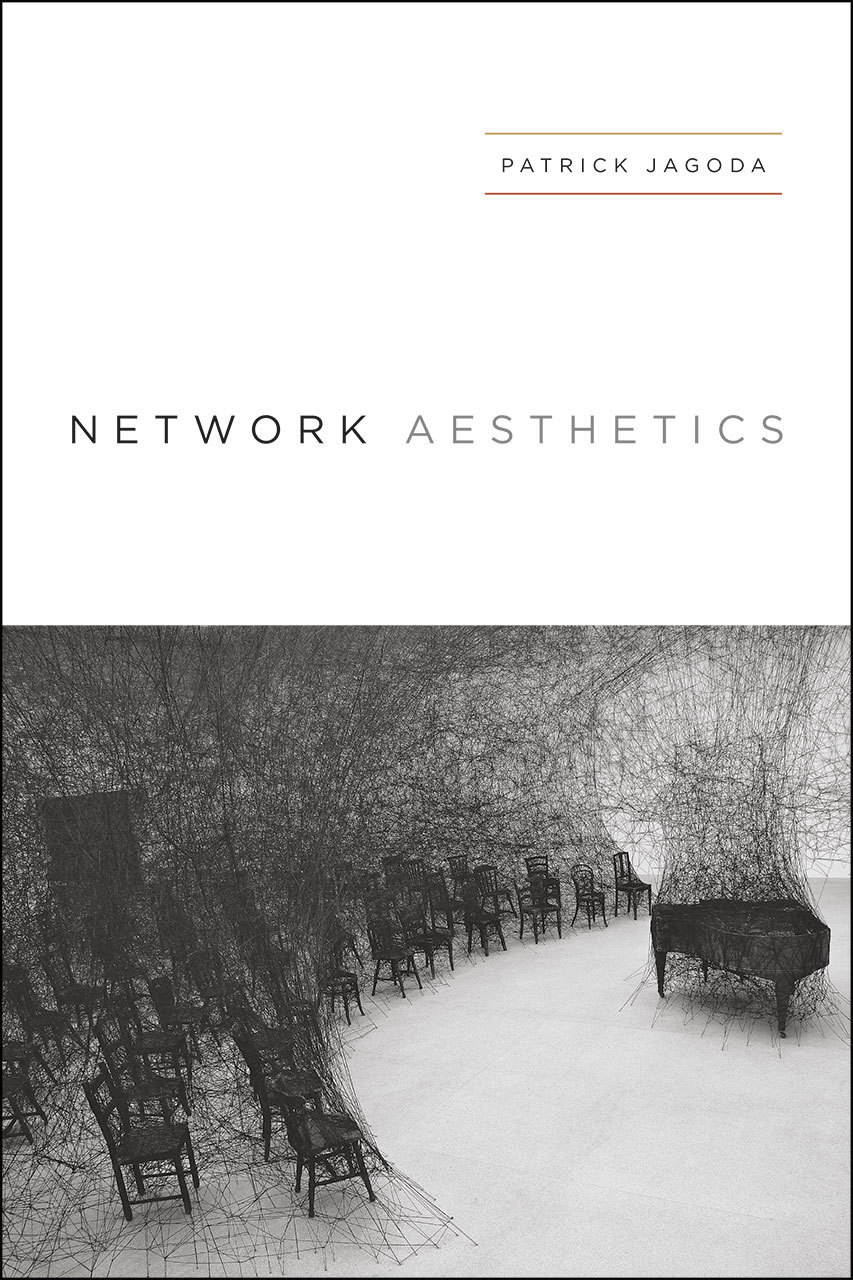
Key Principle
Network Aesthetics is not a monograph of applied theory — it borrows, adapts, and coins selectively. Each thinker provides a specific mechanism the book needs; none is adopted wholesale. The pattern: Jagoda takes a concept, specifies it for network form, and renames or refines it where necessary.
The Thinkers
Jacques Rancière
Concept borrowed: "Distribution of the sensible" (le partage du sensible) Jagoda's adaptation: "Sensibilities of distribution" — the specifically distributed structure of networks reconfigures what can be perceived, thought, and politically recognized. Rancière provides the argument that aesthetics is political at its root (not applied politics, not illustration) and that art cannot guarantee political outcomes but can open or close fields of sensibility. Key move: Art as "practice of dissensus" — rupturing agreement between thought and the sensible, holding the reader in productive suspension. This suspension is structurally homologous to nonsovereignty. (Introduction, chunks 007–008)
Fredric Jameson
Concept borrowed: Cognitive mapping; three stages of capitalism Jagoda's adaptation: Network aesthetics is cognitive mapping for late capitalism's third stage. Jameson hypothesized in 1984 that "a pedagogical political culture" would need to "invent radically new forms" to mediate between individual experience and the "multidimensional set of radically discontinuous realities" of multinational networks. Jagoda's book is the answer. Key move: Mapping as ongoing process (not fixed map) — aesthetic defamiliarization of the network's apparently natural form. Also used against: Jameson's claim that money has become a "flat, boring universal" is refuted by The Wire's differentiated economic texture. (Introduction, Ch. 3, chunks 008–009)
Bruno Latour
Concept borrowed: Actor-Network Theory (ANT); "sociology of associations" Jagoda's adaptation: "Soft eyes" — the wide-angle perceptual disposition ANT requires is given its aesthetic name from The Wire's dialogue. ANT's method (follow the actors, trace associations, resist macro-categories like "Society") is enacted by The Wire formally, not merely described by it. Key move: Latour's slogan "There is no in-formation, only trans-formation" grounds the claim that aesthetic works transform relational understanding, not report it. The ant metaphor for ANT method converges with David Simon's own Baltimore journalism — formal kinship between social science and realist fiction. (Ch. 3, chunks 025, 057–058)
Hannah Arendt
Concept borrowed: Nonsovereign political action; the "web of human relationships" Jagoda's adaptation: The "Arendtian nonsovereign actor" in networked games — a player who initiates action without controlling outcomes, constituted through interdependence rather than mastery. Opposed to Csikszentmihalyi's "flow" (optimal sovereign self-absorption). Key move: Freedom is associated with beginning, not mastery. Action always occurs in a web that exceeds any single actor's intention — this is the theoretical warrant for refusing control-centered accounts of network participation. (Ch. 4, chunk 035)
Lauren Berlant
Concepts borrowed: Sovereignty fantasy; cruel optimism; intimate public; crisis lived within ordinariness Jagoda's adaptation: Sovereignty is "a fantasy misrecognized as an objective state" — this is the theoretical warrant for nonsovereignty as an analytical reorientation. Cruel optimism names the structural bad faith of networks that promise connection while delivering new forms of constraint. "Crisis lived within ordinariness" reframes networked crisis as diffuse everyday texture, not discrete event. Key move: Berlant's diagnosis makes the question "why can't we just opt out?" answerable — sovereignty is the very fantasy the network imaginary maintains. (Introduction, Coda, endnotes throughout, chunks 008, 048, 062)
Brian Massumi
Concepts borrowed: Affect as non-conscious intensity; atmospheric/networked media; singular examples Jagoda's adaptation: Affect is "a non-conscious experience of intensity" that captures "unformed and unstructured potential" — the pre-personal, ambient, relational dimension of living with networked media. Networks and affect theory are mutually constitutive: "The network distributes. Interlinks. Relates... Communicational technologies give body to relationality as such." The "node" as analytical unit — "neither general nor particular" — is the book's micro-level architecture. Key move: Without affect theory, network aesthetics can only account for cognition and representation; it cannot account for the ambient, nonconscious dimensions of how people actually live with networks. (Introduction, Ch. 2, chunks 010, 055)
Michel Foucault
Concept borrowed: Episteme (historical a priori); "Of Other Spaces" network formulation Jagoda's adaptation: "Network form as dominant episteme" — networks are the contingent, historically specific way the early twenty-first century organizes knowledge. The tree (Darwin; Deleuze and Guattari: "We are tired of trees") preceded it; something will succeed it. This denaturalizes network science's ontological claims (Barabási's "weblike universe"). Key move: Foucault's 1986 formulation — "our experience of the world is less that of a long life developing through time than that of a network that connects points and intersects with its own skein" — predates the internet as cultural phenomenon, proving the network as experiential condition is not reducible to digital technology. (Coda, endnotes, chunks 047, 050)
Gilles Deleuze (and Félix Guattari)
Concepts borrowed: Control societies; rhizome; "We are tired of trees" Jagoda's adaptation: Control societies (Deleuze's updating of Foucault's disciplinary societies) provide the historical framing for networked games as sites of control-through-participation rather than discipline-through-confinement. Galloway's Protocol bridges Deleuze's control societies to the specific technical architecture of networked games. The rhizome is acknowledged as a precursor to network thinking but is not Jagoda's own term. Key move: The "whatever" (Galloway drawing on Deleuze and Agamben) is critiqued as a privileged stance; control societies frame is retained for diagnosis without being adopted as a solution. (Introduction, Ch. 4, Coda, endnotes)
David Graeber
Concept borrowed: Baseline communism; three economic principles (Debt: The First 5,000 Years) Jagoda's application: The Wire depicts not "raw capitalism" (Simon's own misreading) but a mediated network of actors negotiating exchange, hierarchy, and communism simultaneously. Graeber's three principles (exchange, hierarchy, communism as baseline human solidarity) reveal that economic texture in the show exceeds any single ideological frame. Key move: Refutes both Simon's anti-capitalism polemic and Jameson's claim that money has become a "flat, boring universal" in contemporary art. Complexity of economic form is the realist content. (Ch. 3, chunk 028)
Quick-Reference Index
| Thinker | Concept Taken | Jagoda's Coin/Adaptation | Chapter |
|---|---|---|---|
| Rancière | Distribution of the sensible | Sensibilities of distribution | Intro |
| Jameson | Cognitive mapping; 3 stages | Network aesthetics as cognitive mapping | Intro, Ch. 3 |
| Latour | ANT / sociology of associations | Soft eyes; network tracing | Ch. 3 |
| Arendt | Nonsovereign action | Arendtian nonsovereign actor | Intro, Ch. 4 |
| Berlant | Sovereignty fantasy; cruel optimism | Nonsovereignty; crisis in ordinariness | Intro, Coda |
| Massumi | Affect; intensity | Atmospheric media; node as unit | Intro, Ch. 2 |
| Foucault | Episteme | Network as dominant episteme | Intro, Coda |
| Deleuze/Guattari | Control societies; rhizome | Control through protocol/games | Ch. 4, Coda |
| Graeber | Baseline communism | Three economic logics in The Wire | Ch. 3 |
Key Quotes
"Aesthetic acts... are 'configurations of experience that create new modes of sense perception and induce novel forms of political subjectivity.'" — Jacques Rancière, cited in Introduction
"cognitive mapping is the 'mental map of the social and global totality'" and "an aesthetic that can 'enable a situational representation on the part of the individual subject to that vaster and properly unrepresentable totality which is the ensemble of society's structures as a whole.'" — Fredric Jameson, cited in Introduction
"Society is the consequence of associations and not their cause." — Bruno Latour, Reassembling the Social, cited in Ch. 3
"Sovereignty is a fantasy misrecognized as an objective state: an aspirational position of personal and institutional self-legitimating performativity and an affective sense of control in relation to the fantasy of that position's offer of security and efficacy." — Lauren Berlant, cited in Introduction
"The network distributes. Interlinks. Relates. The network is the relationality of that which it distributes. It is the being of collective becoming. Communicational technologies give body to relationality as such." — Brian Massumi, cited in Introduction
"We are at a moment, I believe, when our experience of the world is less that of a long life developing through time than that of a network that connects points and intersects with its own skein." — Michel Foucault, "Of Other Spaces" (1986), cited in endnotes
Rules of Thumb
- Check which concept is borrowed, which is adapted, and which is Jagoda's own coinage — conflating them distorts the argument.
- Rancière provides the political warrant for aesthetics; Jameson provides the historical necessity; Latour provides the method; Berlant/Arendt provide the critique of sovereignty.
- When a thinker appears in endnotes only, they are often providing a methodological limit-case, not a central argument — read the note before citing them as central.
- Massumi is the affect theory anchor; Foucault is the historicization anchor; neither is the book's "main" theorist.
Related References
- Core Framework — Network Aesthetics - how these thinkers combine into the book's overall argument
- Nonsovereignty - Arendt and Berlant in fuller detail
- Network Imaginary - Foucault and Rancière in fuller detail