Key Principle
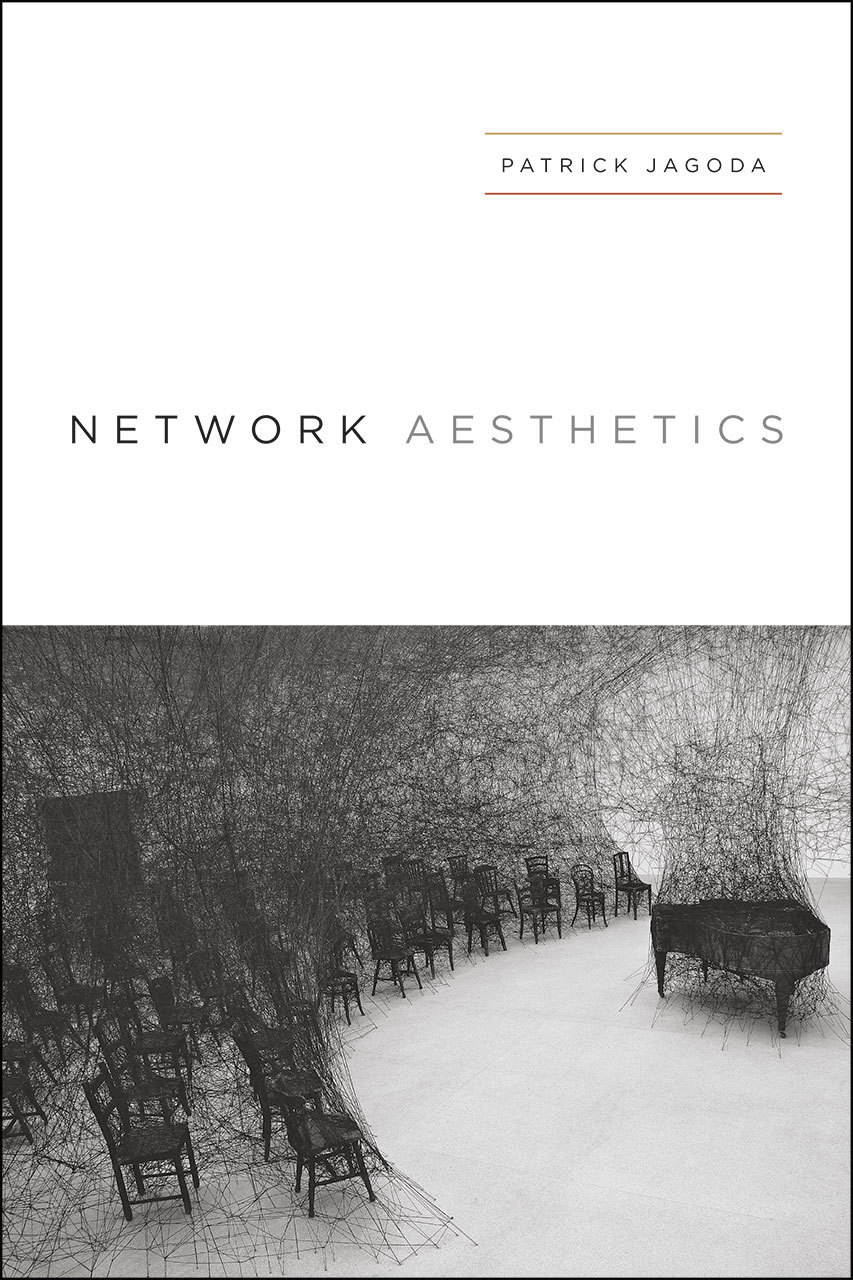
Aesthetic works are irreplaceable modes of sensing network form — not supplements to scientific or sociological knowledge but a distinct epistemological practice in their own right. "The aesthetic qualities of such works are not mere supplements to knowledge but rather unique ways of thinking through ordinary network relations." Five aesthetic modes organize the book's chapters: maximal, emergent, realist, participatory, and improvisational. The critical posture threading through all five is ambivalence as intensive presence — neither avant-garde negation nor uncritical celebration, but sustained attention to what networks offer and foreclose.
Why This Matters
Networks are, in Jagoda's phrase, a "limit concept of the historical present" — accessible "only at the edge of our sensibilities." Network science can map topology; sociology can trace structure; but neither can recover the microlevel affects, the ambient frustrations, the ordinary entanglements that constitute lived network experience. Cultural works access these dimensions through medium-specific affordances: novelistic belatedness, cinematic crosscutting, procedural game mechanics. Without aesthetic analysis, network theory remains trapped in infrastructural and sovereign framings that mistake the map for the territory.
The five modes are not mutually exclusive genres. They are co-present tendencies that different works foreground differently. Isolating each mode allows targeted philosophical inquiry into concepts — event, emergence, realism, play, failure — that network form has "complicated and forever altered." Together, the modes build a transmedia ecology: what appears ubiquitous and total is revealed, through comparison, to be "heterogeneous, fractal, but also mutable."
Good Examples
Journey (thatgamecompany, 2012) strips away language-based communication, leaving players with the ambient sense of another's presence. A fan described the experience as "hard to explain" — "no game has ever made me feel before" the way Journey plays with "the feeling of connectedness." This exemplifies the participatory mode: network sociality made sensible through formal constraint rather than explicit representation.
We the Giants (Groeneweg, 2009) embeds players in asynchronous collaboration where sacrifice is the only agential act — each player's body becomes a stepping-stone for the next. The work "encourages deliberate reflection on the pleasures, uncertainties, frustrations, and dependencies of networked technologies," enacting the book's defamiliarization model at its most compressed.
DeLillo's Underworld demonstrates the maximal mode: overloaded syntax, reverse chronology, and dispersed focalization produce "a linguistic sense of networks that never yields schematic knowledge" — making the reader experience the network's incoherence rather than merely understand it.
Counterpoints
Alexander Galloway argues that networks produce aesthetic uniformity — "Every map of the Internet looks the same... All operate within a single uniform set of aesthetic codes." Jagoda accepts the observation about the network sublime's dominance but rejects the conclusion of unrepresentability: dominance of one aesthetic mode does not exhaust all possible modes.
Galloway and Thacker also conclude that "we do not yet have a critical or poetic language in which to represent the control society." Jagoda's direct rebuttal: "The core project of my book... is to demonstrate that we do in fact have the language for grappling with crucial experiences of (if not the totality of) finance capital, control societies, and network form."
Science fiction, the obvious genre for network themes, is largely set aside in favor of non-speculative US texts from the 1990s–2000s. The departure is deliberate: SF privileges systemic scale and speculative extremity; Jagoda prioritizes "ordinary network experiences" — the normalized, not the extraordinary.
Key Quotes
"Networks, a limit concept of the historical present, are accessible only at the edge of our sensibilities." — Patrick Jagoda, Introduction: Network Aesthetics
"Beyond the sublime of interconnection, which is a dominant mode of encountering systemic totalities, network aesthetics concern the ordinary affects of networked life-worlds — their promises and failures, their freedoms and constraints." — Patrick Jagoda, Introduction: Network Aesthetics
"The aesthetic qualities of such works are not mere supplements to knowledge but rather unique ways of thinking through ordinary network relations." — Patrick Jagoda, Introduction: Network Aesthetics
"[Cultural works] enable readers, viewers, and players to think about networks not merely by knowing or representing them but by feeling and inhabiting them, often through ordinary scenes, interruptions, and contradictions." — Patrick Jagoda, Introduction: Network Aesthetics
Rules of Thumb
- Treat aesthetic form as epistemologically constitutive, not decorative — ask what a work makes sensible, not just what it represents.
- Identify which of the five modes a work foregrounds: maximal (scale and disorientation), emergent (complexity over time), realist (material grounding), participatory (relational play), or improvisational (process and failure).
- The "pedagogy of ambivalence" means refusing both dystopian paralysis before information overload and utopian celebration of connectivity — stay attuned to transformation without rendering a verdict.
- Medium specificity matters: what a novel can do with network belatedness differs from what a game can do through action and interdependence.
- When a concept seems self-evident because it is ubiquitous, that is precisely when aesthetic defamiliarization is most needed.
Related References
- Network Imaginary - Historical formation of the network imaginary that aesthetic works defamiliarize
- Nonsovereignty - The analytical starting point that aesthetic works enact and explore
- Maximal Aesthetics — Network Novels - Chapter 1 case study of the maximal mode in action