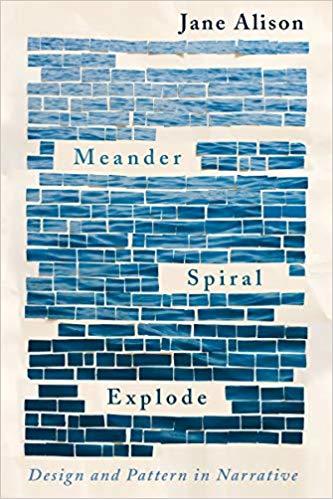
Diagnostic: Which Pattern Does Your Material Demand?
Alison's hylomorphism holds that form should emerge from material, not be imposed externally: "a meander or net or explosion was simply the pattern the material needed" (Epilogue). Ask these questions:
- Does your material move forward in time? If yes: wave, wavelet, or meander. If barely: radial or cellular.
- Is there a single charged event at the center? Radial/explosion -- the story orbits a nucleus.
- Does the material circle back on itself, deepening with each pass? Spiral -- near-repetition around an axis.
- Is there a core situation that replicates at different scales or registers? Fractal -- a compressed seed generating branches.
- Are there discrete, equal-weight segments that gain meaning through juxtaposition? Cellular/network -- reader-drawn connections replace plot.
- Does the material oscillate between two poles without climax? Wavelets -- small repeated oscillations between defined opposites.
- Does the material resist all single patterns? Consider multi-structure design -- layering patterns in what Alison calls a "moire relation with the wave, one pattern upon another" (Epilogue).
Pattern-by-Pattern Implementation
Wave (Chapter 4)
- Build with: Symmetrical scenes on rising and falling sides, mirroring the same elements with transformed meaning. Micro-profluence at the sentence level -- "tiny chains of actions and reactions" (Chapter 4).
- Ending: Resolution through symmetry. The falling side echoes the rising side with changed elements -- the reader feels finished rather than merely stopped.
- Pitfall: A story can have a climax and still feel shapeless if the falling action does not echo the rising action with transformed elements.
Wavelets (Chapter 5)
- Build with: Establish two defined poles (wet/dry, joining/separation, hope/decay). Alternate between them in small increments, paragraph by paragraph. Calibrate perceptibility -- "just barely perceptible, something felt more in the mouth and throat than consciously registered in the mind" (Chapter 5).
- Three endings: Convergence (poles merge, transforming meaning -- Carver), perpetuation (oscillation never resolves -- Wolff), extinction (only death stops the cycle -- Redonnet).
- Pitfall: Too obvious = schematic; too subtle = invisible. The double-note oscillation must sustain "low-level tension that keeps every page agitated" without becoming mechanical.
Spiral (Chapter 7)
- Build with: Identify a central axis (character, narrator, theme). Return to similar territory with each revolution, but shift emotional register so each pass recontextualizes earlier material. Use image-driven forward motion -- carefully sequenced images, not causally linked events, create the reader's sense of change.
- Ending: Since spirals "could go on forever," identify the moment when circling has accumulated enough meaning to justify stopping. The reader should discover the question only upon encountering the answer.
- Pitfall: Without a discernible axis, the spiral degenerates into randomness. Without sufficient variation between revolutions, it stalls into mere repetition. A student who wanted to cut the spiraling images in Dybek's "Pet Milk" missed that they are the lens through which the climactic scene becomes meaningful (Chapter 7).
Radial/Explosion (Chapter 8)
- Build with: Place the core event early or let the reader know it from the start. Commit to a direction -- centripetal (drawing inward toward dread) or centrifugal (scattering outward in avoidance). Accumulate perspectives on the nucleus rather than advancing chronologically.
- Ending: The radial structure shifts attention from what happened to how people relate to the event -- their complicity, failure, avoidance. Resolution comes through moral or perceptual saturation, not climax.
- Pitfall: Without committing to centripetal or centrifugal direction, the narrative circles aimlessly. If told linearly, a traumatic core event argues that the event itself is the point, when the real subject is usually complicity or consequence.
Fractal (Chapter 10)
- Build with: Start with a compressed seed containing the core situation in miniature. Each subsequent branch reproduces the seed's pattern with a different loupe -- magnifying a different element. Ensure genuine difference within repetition to avoid redundancy.
- Ending: The logic of self-replication implies infinite continuation. Solve with a "mad leap" -- a final iteration so surprising it functions as a crash-stop (Lispector, Chapter 10).
- Pitfall: Without sufficient difference between iterations, the structure collapses into redundancy. Test: does the fragmentation enact the thematic content, or is it decorative?
Cellular/Network (Chapter 9)
- Build with: Discrete segments unified by threading motifs that accrue meaning with each appearance. Sebald's method: concrete nouns, no figurative language, recurring figures (Butterfly Man) binding sections into a unified work. "Instead of following a line of story, your brain draws the lines, makes connections" (Chapter 9).
- Ending: "Not so much a stasis of concluded action as a stasis of illumination" (Chapter 9). The reader reaches the end when their growing illumination achieves sufficient density.
- Pitfall: Without threading motifs, discrete cells remain a collection, not a work. Images must progress (not merely accumulate) -- randomness rather than illumination results from uncontrolled juxtaposition.
The Ending Problem (Summary Across Patterns)
| Pattern | Ending Logic | Risk |
|---|---|---|
| Wave | Symmetrical return with transformed elements | Shapelessness if falling side does not echo rising |
| Wavelets | Convergence, perpetuation, or extinction | False climax imposed on incremental material |
| Spiral | Accumulated meaning justifies stopping | Arbitrary cutoff if not enough has accrued |
| Radial | Moral/perceptual saturation | Circling without deepening |
| Fractal | Mad leap -- surprising final iteration | Infinite continuation without crash-stop |
| Cellular | Stasis of illumination | Collection rather than unified work |
Common Execution Pitfalls
- Content-form mismatch: Forcing an arc onto material whose logic is replicative, circular, or networked. "Rather than expecting the 'soul' or animating shape of fiction to be a plotted arc, why not imagine other shapes?" (Introduction)
- Removing the arc's engine without installing another: Non-arc structures require an alternative engine for forward motion -- pattern recognition, image progression, constellatory reading. Without one, the text feels arbitrary or static (Introduction).
- Uniform narrative speed: A narrative with no speed variation has no felt rhythm. Deliberate alternation of gap/summary/scene/dilation/pause creates the currents that hold reader attention (Chapter 2).
- Neglecting micro-level design: Structure operates at every scale. Parataxis vs. hypotaxis, resolution density, and micro-frictions are structural choices, not style preferences (Chapters 1-2).
- Formal experiment without grounding: "Purely cerebral affairs" that "toy on surfaces" result when structure is not grounded in material (Epilogue). The right test: does this form emerge from the content, or is it imposed?
Key Quotes
"Rather than expecting the 'soul' or animating shape of fiction to be a plotted arc, why not imagine other shapes? The arc makes sense for tragedy, but fiction can be wildly other." -- Jane Alison, Introduction
"I believe they've done this organically: a meander or net or explosion was simply the pattern the material needed. Aristotle's hylomorphism: shape ordering life." -- Jane Alison, Epilogue
"The questions a spatial narrative asks are not 'what happens next?' but 'why did this happen?' and, more complexly, 'what grows in my mind as I read?'" -- Jane Alison, Chapter 9
"It feels like a river -- yet looks like a design." -- Jane Alison, Chapter 2
Related References
- Fractal Narratives - Detailed fractal pattern analysis with examples
- Multi-Structure Reading - Layering multiple patterns simultaneously
- Rules of Thumb - Collected heuristics organized by category