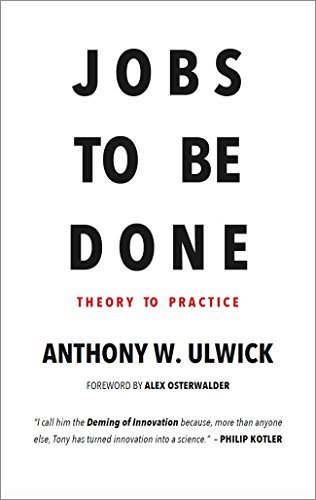
Key Principle
"A common language is needed to unite the many people involved in innovation efforts." -- Ulwick, Chapter 8. Without shared definitions, teams talk past each other, debating solutions while meaning different things by "need," "market," and "opportunity."
Why This Matters
Ulwick argues that roughly 95% of innovation teams cannot agree on what a "need" even is, let alone how to measure one. This definitional chaos means that marketing, engineering, product, and leadership each bring incompatible mental models to the same table. The result is wasted cycles, misaligned roadmaps, and products that solve the wrong problems.
A common language resolves this. When every function uses the same JTBD/ODI vocabulary -- with precise, testable definitions -- disagreements shift from "what are we even talking about?" to "which unmet outcomes should we prioritize?" That is a productive disagreement.
Good Examples
| Term | Definition | First Appears |
|---|---|---|
| Jobs-to-be-Done (JTBD) | The underlying process a customer is trying to execute when using a product or service. | Introduction |
| Desired Outcomes | Customer need statements structured as: direction of improvement + performance metric + object of control + contextual clarifier. | Introduction |
| Outcome-Driven Innovation (ODI) | A data-driven innovation process tying customer-defined metrics to the customer's job-to-be-done. Claims 86% success rate. | Introduction |
| Ideas-First Approach | Brainstorm ideas first, then test with customers. Declared "inherently flawed" because it operates without knowledge of unmet needs. | Ch. 1 |
| Needs-First Approach | Learn customer needs before devising solutions. Fails in practice because companies lack a shared definition of "need." | Ch. 1 |
| Core Functional Job | The primary task the end user is trying to execute. Stable over time, solution-agnostic, geographically boundless. | Ch. 2 |
| JTBD Needs Framework | Taxonomy of six need types: desired outcomes, related jobs, emotional jobs, social jobs, consumption chain jobs, financial desired outcomes. | Ch. 2 |
| Related Jobs | Other functional jobs the end user may want to accomplish alongside the core job. Typically 5-20 per core job. | Ch. 2 |
| Emotional Jobs | How customers want to feel or avoid feeling when executing the core functional job. | Ch. 2 |
| Social Jobs | How the customer wants to be perceived by others when executing the core functional job. | Ch. 2 |
| Consumption Chain Jobs | Jobs across the product lifecycle: purchasing, installing, maintaining, upgrading, disposing, etc. | Ch. 2 |
| Financial Desired Outcomes | Financial metrics a purchase decision maker uses to choose between products or suppliers. Typically 40-80 per buying context. | Ch. 2 |
| Growth Strategy Matrix | 2x2 matrix (better/worse performance vs. higher/lower cost) classifying five strategies: differentiated, dominant, disruptive, discrete, sustaining. | Ch. 3 |
| Job Statement Format | Verb + object of the verb (noun) + contextual clarifier. E.g., "listen to music while on the go." | Ch. 4 |
| Job Map | Core functional job deconstructed into discrete process steps. Solution-agnostic. | Ch. 4 |
| Universal Job Map | Eight fundamental steps all jobs share: define, locate, prepare, confirm, execute, monitor, modify, conclude. | Ch. 4 |
| Desired Outcome Statement | Direction of improvement + performance metric (time or likelihood) + object of control + contextual clarifier. | Ch. 4 |
| Opportunity Algorithm | Opportunity = importance + max(importance - satisfaction, 0). Score of 10+ indicates underserved. | Ch. 4 |
| Opportunity Landscape | Plot of outcomes by importance vs. satisfaction with three zones: underserved, appropriately served, overserved. | Ch. 4 |
| Three Customer Types | End user (job executor), product life cycle support team (install/maintain/repair), purchase decision maker (financial outcomes). | Ch. 4 |
| Market (ODI definition) | A group of people and the core functional job they are trying to get done -- defined around jobs, not products or demographics. | Ch. 8 |
| Innovation (ODI definition) | Devising a product or service concept that addresses unmet needs, enabling the customer to get a job done better and/or more cheaply. | Ch. 8 |
| Opportunity (ODI definition) | An unmet need -- either underserved (important and poorly satisfied) or overserved (unimportant and very well satisfied). | Ch. 8 |
| 84-Step ODI Process | End-to-end process across six phases: Initiate (15), Uncover Needs (18), Gather Data (18), Discover Opportunities (10), Market Strategy (12), Product Strategy (10). | Ch. 6 |
Counterpoints
- "Job" is often confused with a task, activity, or user story. A JTBD is a stable process independent of any solution -- not a feature request.
- "Desired outcome" is frequently conflated with a solution requirement or a user preference. It is a measurable performance metric with a strict grammatical structure.
- "Disruptive" is widely misused as a synonym for "innovative." In ODI, it has a precise meaning: targeting overserved customers or nonconsumers with a cheaper, lower-performing product.
- "Latent needs" -- the idea that customers have needs they cannot articulate -- is rejected by Ulwick. The real problem is that companies fail to define what a need is, not that customers cannot express them (Ch. 1).
Key Quotes
"A common language is needed to unite the many people involved in innovation efforts." -- Ulwick, Chapter 8
"When asked what a 'need' is, 95 percent of the time managers cannot agree." -- Ulwick, Chapter 1
"New products win in the marketplace if they help customers get a job done better and/or more cheaply." -- Ulwick, Chapter 3
Rules of Thumb
- When defining a job, use the format: verb + object + contextual clarifier. If it names a solution or technology, it is not a job.
- When writing a desired outcome, always include: direction of improvement + metric (time or likelihood) + object of control + clarifier. If any element is missing, revise.
- If a term provokes debate in a meeting, check this glossary before continuing. Most JTBD arguments are vocabulary arguments.
- Treat the Opportunity Algorithm threshold of 10+ as the standard cutoff for "underserved." Below 10 is appropriately served or overserved.
- "Market" in ODI always means people + job, never a product category or demographic segment.