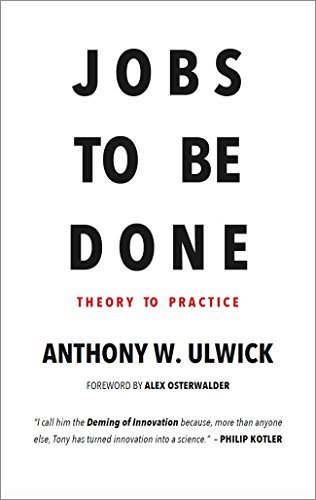
Key Principle
Innovation becomes predictable when you apply Six Sigma process-control thinking not to your own production line, but to the customer's process. The unit of analysis is the job -- the stable functional task the customer is trying to execute (e.g., "restore blood flow in a blocked artery," "listen to music"). Attached to each step of that job are desired outcome statements: structured, measurable, solution-agnostic metrics that capture how the customer defines success. When you know these metrics before ideation begins, you replace guesswork with quantifiable targeting.
"It occurred to me that we could apply Six Sigma and process control principles to innovation if we studied the process that people were trying to execute when they were using a product or service, rather than studying the product itself." -- Tony Ulwick, Introduction
The framework organizes all customer needs into six types (core functional outcomes, related jobs, emotional/social jobs, consumption chain jobs, financial outcomes, and the core functional job itself), each serving a distinct strategic function. Desired outcomes are the primary type: typically 50-150 per job, each deliberately constructed to be measurable, solution-agnostic, stable over time, and controllable by the company.
Why This Matters
Innovation fails at scale not because companies lack ideas, but because they lack agreement on what counts as a customer need. 95% of managers cannot agree internally on what a "need" is (Chapter 1). Without a shared definition, teams collect qualitative "voice of the customer" data -- feature requests, complaints, wish lists -- that different stakeholders interpret differently. Prioritization becomes political rather than empirical. The ideas-first approach (used by 68% of large businesses) generates solutions before identifying unmet needs, navigating a combinatorial space of ~14 million possibilities by guesswork, yielding 10-20% success rates (Chapter 1).
ODI solves this by providing a rigorous unit of analysis. Desired outcome statements can be scored by importance and satisfaction across a customer population, revealing precisely which needs are underserved. This converts innovation from subjective debate into quantitative targeting. The method achieves an 86% success rate (18 of 21 launched products) versus the 17% industry average (Introduction).
Good Examples
Cordis Corporation (Introduction): Ulwick identified 75 desired outcome statements for interventional cardiologists executing "restore blood flow in a blocked artery," then quantitatively measured which outcomes were underserved. Result: 19 products launched, all reaching #1 or #2 market position; market share from 1% to over 20%; stock price more than quadrupled.
"Listen to music" outcome statements (Chapter 2): "Minimize the time it takes to get the songs in the desired order for listening" and "minimize the likelihood that the music sounds distorted at high volume" -- these illustrate how outcomes are measurable, solution-agnostic (valid from vinyl to streaming), and stable over time.
Telescopic pointer to wireless presenter (Chapter 2): By identifying related jobs (advancing slides, timing presentations) alongside the core job, the product evolved from a single-function tool into a platform-level solution addressing multiple jobs simultaneously.
Counterpoints
ODI does not guarantee execution. Three of 21 products failed despite correct insight because the companies "did a poor job of executing the commercialization of the product" (Introduction). Knowing what to build and knowing how to build/sell it are distinct competencies.
The "latent needs" myth as self-defeating assumption. Companies that believe customers have needs they cannot articulate (Hamel, Prahalad, Lafley) conclude that a complete needs inventory is impossible -- so they never invest in the methodology to achieve one. The myth is self-fulfilling: poorly structured interviews produce vague responses, which are attributed to customer cognitive limitations rather than to the interviewer's lack of rigor (Chapter 1).
Anchoring innovation to product categories instead of jobs. Companies that frame innovation as "how do we improve our CD player?" are blindsided when the job ("listen to music") migrates to a different solution platform. The product-centric frame makes disruption invisible until it has already occurred (Chapter 2).
Key Quotes
"A company can dramatically increase its chances for success at innovation if it knows precisely what metrics customers use to measure success and value when getting a job done." -- Tony Ulwick, Introduction
"The mathematical probability of someone coming up with an idea that satisfactorily addresses all the customer's unmet needs without knowing what they are or whether or not they are satisfied is close to zero." -- Tony Ulwick, Chapter 1
"Despite all the talk about satisfying customer needs, there is very little understanding of what characteristics a customer need statement should possess and what the structure, content, and syntax of a need statement should be." -- Tony Ulwick, Chapter 1
"Innovation is transformed from a game of chance to a science when the customer's desired outcomes (customer metrics) are known in advance of ideation." -- Tony Ulwick, Chapter 2
Rules of Thumb
- The job, not the product or customer demographic, is the correct unit of analysis for innovation strategy -- jobs are stable across time, geography, and technology shifts.
- Desired outcomes must be measurable, solution-agnostic, stable, and controllable; if a "need" lacks these properties, it is not yet an outcome statement.
- Expect 50-150 desired outcomes per job (200+ in complex markets like healthcare).
- A new product that gets the job done 20%+ better than alternatives is "very likely to win in the marketplace" (Chapter 2).
- Speed applied to a bad process produces faster failure, not faster success -- define the target before accelerating ideation.
- Never conflate need types: functional outcomes, emotional jobs, financial outcomes, and buyer criteria serve different strategic functions and must be captured and prioritized separately.
- "Coming up with the winning solution is not the customer's responsibility. It is the responsibility of the company." (Chapter 1)
Related References
- ODI Process & Opportunity Algorithm -- the 10-step method and quantitative prioritization mechanics (Chapters 3-4)
- Market Strategy & Segmentation -- outcome-based segmentation and competitive positioning (Chapters 5-7)