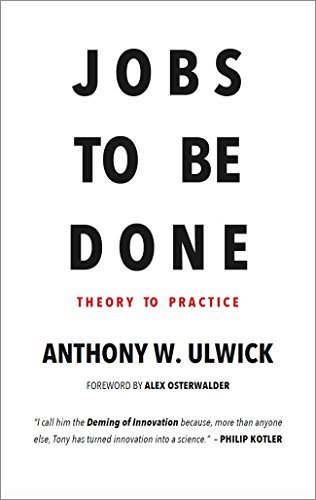
Key Principle
ODI operationalizes innovation through an 84-step process across six sequential phases, where each phase produces a specific deliverable that feeds the next. The process encodes causal dependencies that ad hoc innovation ignores: foundational alignment (Phase I) feeds qualitative needs capture (Phase II), which feeds quantitative survey design (Phase III), which feeds segmentation and opportunity discovery (Phase IV), which feeds market strategy (Phase V), which feeds product strategy (Phase VI). At the organizational level, innovation succeeds not by training everyone but by separating "what to build" (a small Innovation Center of Excellence) from "how to build" (the rest of the organization).
"Most companies are great at creating products — they just aren't that great at creating the right products." — Ulwick, Chapter 7
Why This Matters
The 84-step structure makes it structurally impossible to skip the steps that cause innovation failure. Without it, teams jump from a vague sense of the customer straight to ideation, bypassing needs capture and quantitative validation entirely. The process is deliberately exhaustive not because innovation theory is complicated, but because innovation failure stems from skipping steps.
At the organizational level, the "what to build" / "how to build" separation addresses the actual bottleneck in most companies: target selection, not execution capability. Broad "train everyone" innovation programs conflate insight generation with cultural change. Cultural change is slow, expensive, and unnecessary when the real deficit is a small, specific analytical capability that a dedicated team can own.
Good Examples
Phase I as load-bearing foundation. Phase I produces agreement on exactly four things: (1) project scope, (2) who the customer is, (3) the Job-to-be-Done definition, and (4) the preliminary job map. These are the axioms from which all downstream analysis derives. If a cross-functional team disagrees on who the customer is, every desired outcome statement captured in Phase II will be measured against the wrong population in Phase III. — Chapter 6
Three-phase organizational transformation. The transformation program (4-6 months per product team) produces cumulative thinking shifts: Phase I shifts from product-centric to customer-centric framing; Phase II (180-3,000 customer survey) shifts from intuition to data, producing a long-term asset because jobs and outcomes are stable over time; Phase III trains the broader organization to use the data for marketing, sales, product repositioning, ideation, R&D prioritization, and M&A decisions. — Chapter 7
Six Sigma as organizational on-ramp. Companies that build the Innovation Center of Excellence around an existing Six Sigma program see the best results, because those practitioners already possess process discipline, statistical fluency, and comfort with structured analytical work. ODI is the application of process-control thinking to the customer's job rather than the manufacturing line. — Chapter 7
Counterpoints
Skipping Phase I alignment. Misalignment on the customer or job definition propagates silently through the entire engagement, producing precisely targeted solutions to the wrong problem. This is the most dangerous failure mode because it looks like rigor while delivering irrelevance. — Chapter 6
Having data without application training. Having Phase II quantitative data without Phase III training on its applications leaves insights stranded. The before/after thinking-shift tables function as diagnostic tools — if a team still exhibits "before" thinking after a phase, the phase was not executed effectively. — Chapter 7
Diffuse innovation programs vs. permanent consultant dependence. Without the Center of Excellence model, companies default to one of two failure modes: (a) "train everyone" programs that diffuse effort without producing actionable insight, or (b) permanent dependence on external consultants who leave no residual organizational capability. — Chapter 7
Key Quotes
"I also remember how I'd wished that someone would come along and offer me the process, tools and instructions I would need to be successful." — Ulwick, Chapter 6
"Most companies are great at creating products — they just aren't that great at creating the right products." — Ulwick, Chapter 7
"Decisions are made using quantitative customer insights. Intuition is not acceptable." — Ulwick, Chapter 7
Rules of Thumb
- The 84-step process exists to prevent skipping; every phase produces a deliverable that the next phase consumes — remove any link and the chain breaks.
- Phase I alignment on customer, job, and job map is non-negotiable; downstream errors from misalignment are silent and compounding.
- The ODI practitioner is a competency-stacking generalist (interviewer, survey designer, analyst, strategist, facilitator), not a specialist — this is the bottleneck for scaling.
- Separate "what to build" (Center of Excellence) from "how to build" (rest of organization); do not try to make innovation everyone's job.
- Build the Center of Excellence around Six Sigma practitioners when possible — they already have the process discipline and statistical fluency ODI demands.
- Phase II research is a long-term asset: because jobs and outcomes are stable, the data remains valid for years, not months.
- Use thinking-shift diagnostics: if a team still exhibits "before" thinking after a phase, the phase failed.
- Budget 4-6 months per product team for the full three-phase transformation; shortcuts produce partial thinking shifts that do not stick.
- The practitioner role is hard to fill — plan for it as the primary scaling constraint, not budget or tooling.
- Quantitative validation (Phase III survey of 180-3,000 customers) is what converts qualitative insight into defensible strategy; skipping it leaves you with hypotheses, not evidence.