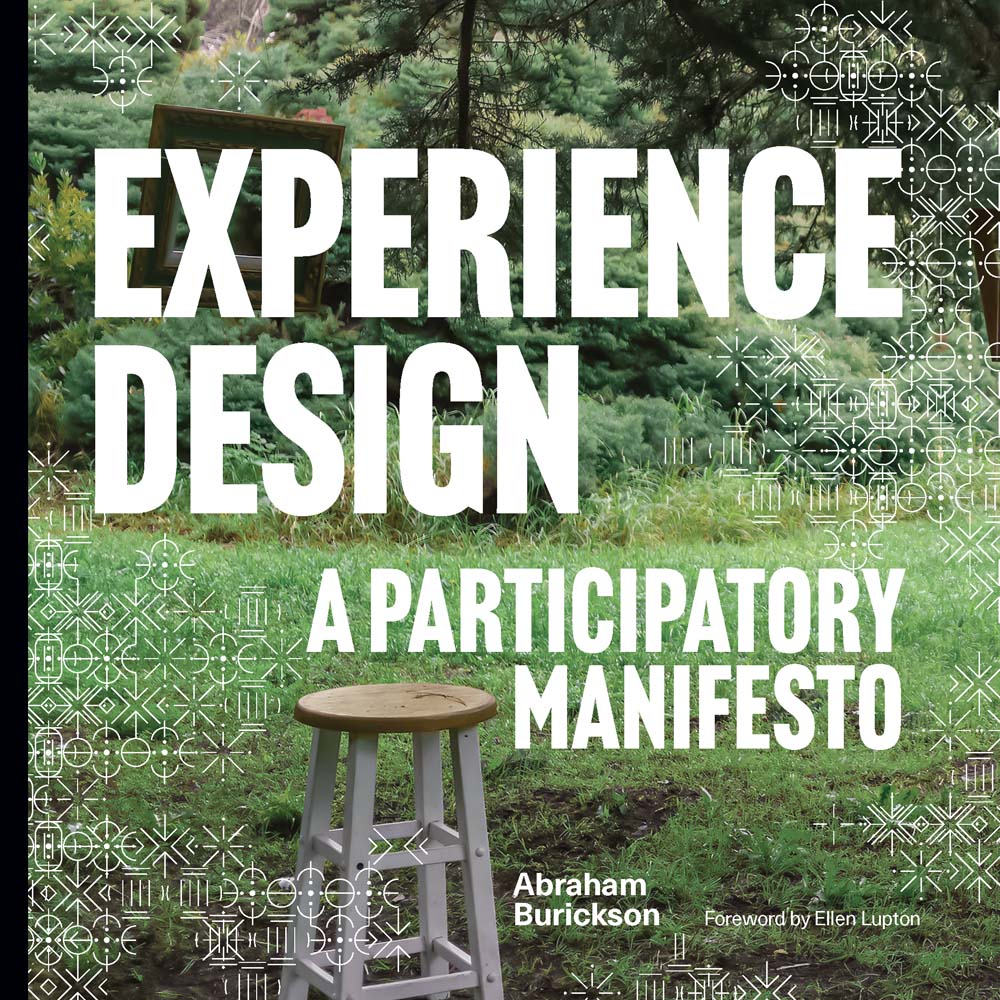
Key Principle
Experience design inverts the conventional design sequence. Instead of starting with a form (a building, a play, a product) and hoping experience follows, the designer begins by identifying the desired experience, then determines content, then selects form. Burickson calls the pre-design stage where this inversion happens Phase Zero: "An experience designer tosses out the traditional form-then-content process in favor of an experience-then-content-then-form process." (p. 14)
The foundational axiom is a two-step claim. First: "All designs are experiences" (p. xvi) — the artifact is a vehicle, the experience is the product. Second: "All we have are experiences" (p. xvii) — lived reality is the only court of appeal. A design cannot be called good despite a bad experience; the experience is the verdict.
Why This Matters
Thing-based design collapses the design space before it opens. A designer who defaults to their trained medium — film, architecture, theater — pre-selects temporal, spatial, and relational affordances before any real design thinking occurs. "A play lasts 1-3 hours, fixes the actor-audience relationship, and may or may not have a set" (p. 12). These constraints silently eliminate experiences the designer never even considers.
The result: designers produce artifacts optimized for their own properties (aesthetics, function, polish) while missing the actual site of value — what happens in the person encountering them. They think about "the stage directions rather than the anticipation of the lights going down in the theater," "the kitchen appliances rather than the joy of cooking together," "the book jacket rather than the thrill of page one" (p. xiii).
Without Phase Zero, the client gets a house, not a home. "A house is a spot on a map. A home is an orientation in the world. A house is finished when the certificate of occupancy is issued. A home is never finished so long as humans occupy it." (p. 13)
Good Examples
The Lightning Field. Walter De Maria's land art installation succeeds not because of lightning (most visitors never see it) but because of what the logistical design does to attention. Months of booking, hours of desert driving, a pickup truck transfer, a remote cabin with pre-made enchiladas — every step removes decisions and planning, freeing attention for the experience itself. "You were advertised natural spectacle, but you were given unstructured time in a beautiful place." (p. 7) The difficulty of the approach is priming, not friction: "Everything that led up to your being here primed you to seek beauty." (p. 7)
Long Architecture. Designing homes from experiential outcomes rather than structural defaults: closets sized to discourage overconsumption, living rooms stripped of couches to encourage children's floor play, rainwater channeled as an indoor fountain to connect inhabitants to natural rhythms. The diagnostic question: "How could a home help one become the person one wants to be?" (p. x)
The Gift as Relational Design. A book-as-gift encodes an empathetic claim ("I understand your interests"). Its wrapping, timing, and framing narrative stage a moment of revelation. The recipient tests the claim by reading. "A gift demands reciprocity, becoming both bonding agent and symbol of your relationship." (p. 10) Cash eliminates this relational mechanism, which is why economists who advocate cash miss the experiential layer.
Counterpoints
The Immersion Fallacy. Sensory overwhelm is not the mechanism of meaningful experience. "Take a hot shower with good shampoo — that's immersion, too, and possibly more satisfying than many ticketed events." (p. ix) Chasing spectacle — more projections, more interactivity, more sensory channels — produces experiences that extract from participants rather than giving to them.
Totalitarian Design. Phase Zero must preserve openness. Designing experiences "as if they are things, without empathy, without relationality, without the unknown" produces something inhuman. "A world with no unprogrammed choices, no true unknown, is not a human world." (p. 14) Even a perfectly executed experiential aim becomes oppressive if it eliminates genuine participation and choice.
Affordance Myopia. Traditional affordances stop at the immediate action (cup holder holds cup). Experiential affordances trace forward through cascading possibility chains: cup holder affords bringing coffee, which affords comfort on long drives, which affords time for audiobooks. Designing for the first link alone produces objects optimized in isolation from the life contexts where they matter. (pp. 8-9)
Key Quotes
"What does it mean to design experiences? Traditional design practices invite us to design things, and to use those things to solve problems. But experience is not a problem; it is life." — Abraham Burickson, p. 2
"That's what we're here to talk about: you as you read, not the book. The experience, not the thing." — Abraham Burickson, p. 3
"Phase Zero asks not What kind of house are you hoping to build but What kind of life are you hoping to build?" — Abraham Burickson, p. 13
"The experience design of a chair is never complete in itself and must, therefore, be thought of as an intervention in the continuity of a user's life, realized in partnership with them." — Abraham Burickson, p. 9
"Humility is, therefore, the first necessary tool." — Abraham Burickson, p. 9
Rules of Thumb
- Always ask "What experience are we trying to create?" before "What will we make?" — this is Phase Zero.
- Trace every design element forward through at least three links of its experiential affordance chain.
- Treat participant state (emotional, cognitive, physical) at the moment of encounter as a design variable, not background noise.
- Design logistical scaffolding that removes decisions, planning, and waiting — freeing attention for the experience itself.
- Preserve genuine unknowns in the design; total control produces oppression, not transformation.
- Test your experience against the hot-shower bar: if it cannot beat a simple moment of genuine comfort, the problem is missing depth, not insufficient stimulation.
Related References
- Rigorous Empathy - Empathy as the primary research tool for understanding participant inner life
- How Experiences Are Framed - Frames as structures that make participation possible without chaos
- Worldbuilding: Four Elements of a World - Worldbuilding as the gravitational center of the experience design methodology