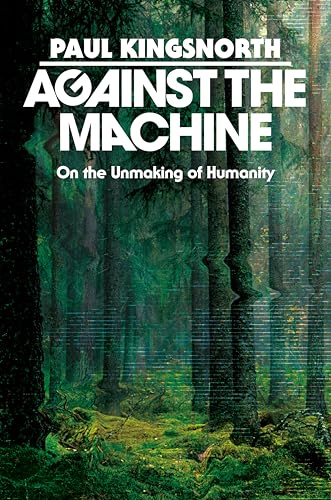
Key Principle
The Machine is not a collection of technologies but "a tendency within us, made concrete by power and circumstance" (Chapter IV). It manifests as "an intersection of money power, state power and increasingly coercive and manipulative technologies, which constitute an ongoing war against roots and against limits" (Chapter IV). Its endgame is "the replacement of nature with technology, in order to facilitate total human control over a totally human world" (Chapter IV).
Kingsnorth's opening epigraphs establish the conflict as ontological, not political. Berry's creature-machine binary asks what kind of being humans choose to become. Clarke's aspiration to "create" God reveals that the Machine carries its own theology -- one where the human replaces the divine rather than submitting to it. The framing device is not left vs. right but creature vs. machine, and every subsequent chapter (enclosure, technique, datafication, transhumanism) is an instance of this single binary. Without this frame, those chapters read as separate complaints; with it, they form a unified diagnosis.
The Machine is not modern. Mumford traces the megamachine to Pharaonic Egypt -- entire societies ordered from the top down, "justified by a mythos employed by its leaders and driven by a desire for 'order, power, predictability and above all, control'" (Chapter IV). Each civilisational iteration inherits the myth from the last. Because the Machine is sustained by myth rather than material fact, liberation begins cognitively: stop believing the story, stop telling it, begin the search for a better one (Mumford, via Chapter IV).
Ellul names the Machine's animating logic "technique" -- not technology but the worldview that "make[s] quantitative what is qualitative," replacing organic life with rationalised outcomes (Chapter XI). Technique requires no conspiracy: "There is no wizard. There is no curtain" (Chapter XI). It operates through sheer dominance of its own logic, tending toward a condition in which "it would be impossible to escape the Machine and its assumptions" (Chapter XI).
Technique destroys three foundations of human civilisation: nature, culture, and religion (Chapter XI, via Ellul). It "destroys, eliminates or subordinates the natural world," provokes cultural breakdown across all peoples, and is incompatible with any religious claim to authority beyond the rational. This triad gives the Machine its civilisational scope: it is not reforming human life but replacing its foundations.
Why This Matters
If you read the Machine as merely "capitalism" or "technology," the book's spiritual prescriptions -- prayer, askesis, sacred order -- look like category errors. But the Machine is an ontological programme: it wages war on creaturely existence itself, destroying the three foundations Ellul identifies -- nature, culture, and religion (Chapter XI). Naming it correctly is the precondition for any coherent resistance. Without the creature-machine frame, critiques of growth, surveillance, and globalisation remain separate complaints rather than a unified diagnosis.
The stakes are existential because the Machine's most distinctive power is absorbing its own opposition. Communism and fascism were "arguably the purest manifestation of the politics of the Machine yet seen" (Chapter IV). The green movement mutated into "a Machine accelerant" (Chapter IV). The Machine's operating code -- "Progress; 'openness'; an objection to limits and borders; therapeutic individualism; universalism; the rejection of roots, place and history; pure materialism" -- is invisible because ubiquitous, "treated as natural as rain" (Chapter IV). What you cannot name, you cannot resist.
Good Examples
- The megamachine's continuity: Mumford's provocation that the Egyptian pyramids are "the precise static equivalents of our own space rockets" -- "Both devices for securing, at an extravagant cost, a passage to Heaven for the favoured few" (Chapter IV). The Machine is a recurring civilisational pattern, not a modern invention. The workers who built the pyramids "had minds of a new order: mechanically conditioned, executing each task in strict obedience to instructions" (Chapter IV) -- the factory mentality predates the factory by millennia.
- Co-optation as immune system: The green movement's transformation from simplicity advocacy into a Machine accelerant demonstrates that opposition framed in the Machine's own terms (efficiency, growth, policy) gets absorbed. Even revolutionary movements (communism, fascism) became the Machine's "purest manifestation" (Chapter IV). The Machine does not need to defeat its opponents; it only needs to reformat them.
- The digital trap: The internet, promised as liberation, functions as surveillance and control. Kingsnorth observes that "the web; the net...These are things designed to trap prey" (Chapter XI). We "surrender every detail about ourselves to state and commercial interests in exchange for dopamine hits" (Chapter XI). The industrial revolution replaced muscle; the digital revolution replaces the brain -- and the trap is now in our pockets.
Counterpoints
- "Is the Machine just capitalism?" -- No. Capitalism is one expression. Communism and fascism were others. The Machine predates capitalism (Mumford's Pharaonic megamachine) and transcends it (technique colonises domains untouched by markets -- schools become exam factories, farms become laboratories). The root is technique, not a specific economic arrangement. McCarraher's insight deepens this: modernity did not disenchant the world but substituted a new enchantment -- "Capitalism, it turns out, might be modernity's most beguiling form of enchantment" (Chapter IV, quoting McCarraher).
- "Is there really no wizard behind the curtain?" -- Ellul insists technique is autonomous: "Efficiency is a fact, and justice a slogan" (Chapter XI). This raises the tension between structural critique and moral agency. If no one directs the Machine, who is culpable? Kingsnorth's answer: the myth sustains it, so every believer is complicit, and every act of disbelief is resistance.
- "Can the Machine's tools be turned against it?" -- The co-optation thesis suggests not. The Machine absorbs opposition framed in its own logic. Berry's Great Division -- creature vs. machine -- implies that the tools themselves carry the worldview. Using the Machine's instruments to fight it risks becoming what you oppose. Technique "pursues its own course more and more independently of man," reducing the human to "a slug inserted into a slot machine" (Chapter XI, quoting Ellul).
Key Quotes
"The Machine manifests today as an intersection of money power, state power and increasingly coercive and manipulative technologies, which constitute an ongoing war against roots and against limits." (Chapter IV)
"The one lasting contribution of the megamachine was the myth of the machine itself: the notion that this machine was, by its very nature, absolutely irresistible -- and yet, provided one did not oppose it, ultimately beneficent." (Chapter IV, quoting Mumford)
"Man himself is overpowered by technique and becomes its object." (Chapter XI, quoting Ellul)
"It is easy for me to imagine that the next great division of the world will be between people who wish to live as creatures and people who wish to live as machines." (Epigraph / Chapter XI, quoting Berry)
Rules of Thumb
- Name the system, not just the symptom. If your critique targets only capitalism, only technology, or only the state, you are looking at one limb of the Machine. The creature-machine binary is the diagnostic frame.
- Check for the myth. The Machine persists because people believe in it. When growth is invoked as self-justifying -- solving problems it caused with more of itself -- you are hearing the myth of the machine. "Growth for the sake of growth is the ideology of the cancer cell" (Chapter IV, quoting Abbey).
- Watch for co-optation. If a resistance movement adopts the Machine's operating code (efficiency, universalism, the rejection of limits), it has already been absorbed. The green movement is the cautionary tale.
- Technique colonises invisibly. When qualitative realities are made quantitative -- exam scores for learning, GDP for wellbeing, metrics for meaning -- technique is at work. "Farms become laboratories, schools become exam factories" (Chapter XI).
- Liberation is first cognitive. Because the Machine is sustained by myth, the first act of resistance is disbelief. Mumford's three steps: stop believing the story, stop telling it, begin the search for a better one.
- Ask "creature or machine?" Berry's Great Division is the orienting question. In any domain -- food, education, medicine, community -- ask whether the direction of travel serves creaturely life or machine logic. "The tension between the virtual and the real, the digital and the organic, the constructed and the born" (Chapter XI).
- The Machine destroys three foundations. Nature, culture, religion (Chapter XI, via Ellul). If your analysis of a problem does not touch at least one of these, you may be treating a symptom rather than the disease.
Related References
- The Western Deviation - how the West arrived at the Machine
- Technique and the Mechanistic Revolution - the Machine's animating logic
- The Four Ps and Four Ss - what the Machine replaces