Key Principle
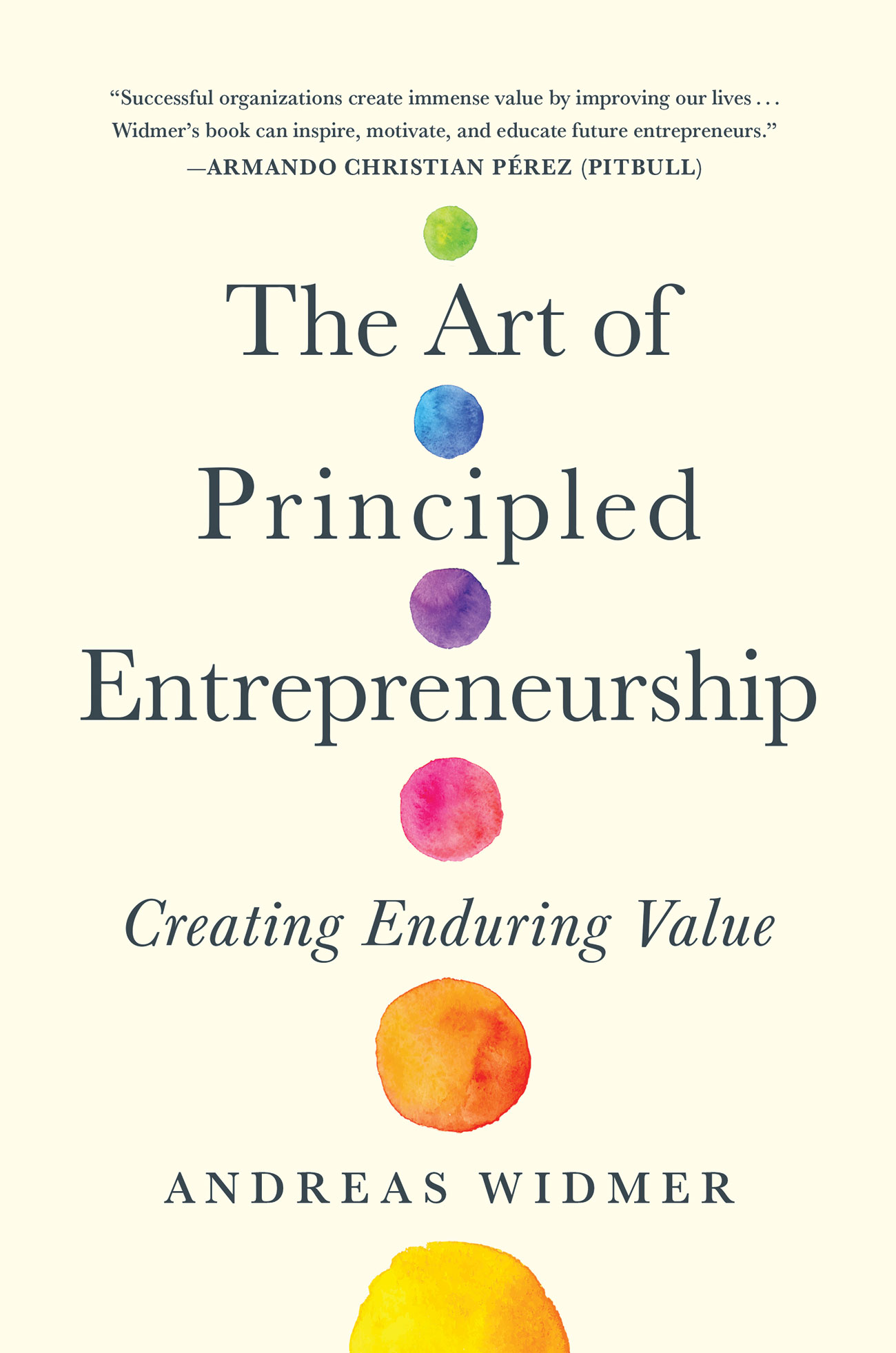
Principled Entrepreneurship (PE) is the practice of maximizing long-term profitability by creating superior customer value while consuming fewer resources and acting lawfully with integrity. Its central claim: when profit flows from value creation rather than extraction, the entrepreneur's self-interest and society's interest align automatically. (Front Matter; Chapter 1)
This thesis is proven across five sequenced pillars:
- The economy exists for people -- Business starts with "How may I help you?" (Ch. 3)
- Work as creation -- Create goods that are truly good, support human flourishing, reward stakeholders financially. (Ch. 4)
- Culture over strategy -- "Culture is what we do when no one is looking." (Ch. 5)
- Win-win competition -- Free competition is collaborative, not destructive. Competitors are "collaborators in our mutual perfection." (Ch. 6)
- Creator mindset -- Creators treat the balance sheet as a means to customer value; harvesters treat customer value as a means to the balance sheet. (Ch. 7)
The pillars are sequenced, not interchangeable. Person-centeredness (1) motivates creative work (2), which requires culture to sustain (3), which produces genuine competition (4), which demands a creator rather than harvester orientation (5). Remove any one and the downstream pillars collapse. (Chapter 1)
Why This Matters
Without the PE framing, entrepreneurship defaults to zero-sum thinking where profit is assumed to come at someone else's expense. Entrepreneurs then either pursue profit through extraction -- depleting talent, trust, and innovation capacity -- or they subordinate profit to values, creating unsustainable businesses. Both failures stem from accepting what Arthur Brooks calls "the false choice" between creative expression, good values, and strong profits. (Front Matter)
The architecture matters because PE is not a checklist but five angles on a single causal claim: value creation produces durable alignment. The book's entire argument depends on proving this mechanism holds across economics, work, culture, competition, and mindset. (Chapter 1)
Good Examples
The Nordhaus Data Point: Nobel laureate William Nordhaus found that innovator-entrepreneurs capture only 2% of the value they create; 98% flows to employees and society. One dollar invested in an SME generates $13 of local economic value. This demolishes zero-sum framing -- constraining entrepreneurial activity destroys roughly 50x more social value than it redistributes. Per Andy Kessler: for every dollar of government taxation/regulation of companies, approximately $25 of compound social wealth is theoretically destroyed. (Chapter 2)
The Creator-Harvester Continuum: Every company sits on a creating-harvesting spectrum. Creators invest current profits into future customer value; harvesters extract current value to inflate current profits. Art Ciocca's Wine Group exemplifies the creator end -- structural bylaws prevent sale of the company except in financial failure, eliminating the temptation to harvest. The position is not binary but a daily management decision -- "an art, not a formula." (Chapter 1; Chapter 7)
Wine Industry Cooperation: California wineries compete in sales and marketing but cooperate in production and winemaking knowledge, reasoning that "if some wineries produce substandard wine, it is a bad reflection on all wine." Result: compounded industry growth of ~3% per year for forty years. (Chapter 1)
Counterpoints
Harvesting is not always wrong: "That does not mean that a creator never harvests." There is a time to plant and harvest, but a good farmer harvests with care for the land and an eye toward the next season. (Chapter 7)
Crony capitalism breaks the mechanism: When businesses use government to raise barriers to entry, profit no longer signals value creation -- it signals political access. Crony capitalism is win-lose: incumbents win, society loses through inferior products and destroyed social mobility. PE insists on "lawfully and with integrity" as a structural constraint, not an afterthought. (Chapter 1)
SME decline is real: Since 1978, new firm formation declined 44% (from ~50% of total firms to ~8% by 2012). This correlates with social mobility dropping from 92% of people out-earning their parents (1940s) to 50% today. The PE framework depends on entrepreneurial activity that is structurally declining. Since 1990, MNCs eliminated ~4M jobs while SMEs added ~8M. (Chapter 2)
Key Quotes
"If profit is generated by Principled Entrepreneurship -- by creating value for others -- then your success is in harmony with the success of your customers, employees, suppliers, communities, and society at large." -- Andreas Widmer, Front Matter (quoting Charles Koch)
"Many people today argue that in business, we have to choose: creative expression, good values, or strong profits. This is a false choice, as Andreas Widmer shows masterfully." -- Andreas Widmer, Front Matter (quoting Arthur C. Brooks)
"Harvesting eventually depletes the source and prevents long-term success." -- Andreas Widmer, Chapter 1
"Making decisions in business is more of an art than a science. It's like noticing the texture of fabrics with the pads of your fingers and then following your gut." -- Andreas Widmer, Chapter 1
Rules of Thumb
- Profit is a signal, not a goal: it indicates value created minus value consumed
- If you would not cannibalize your own product, a competitor will -- creative destruction must happen on your terms
- The four entrepreneur types (employee ~100%, acquisition ~80%, franchise ~40%, startup ~5%) represent progressive skill development, not a hierarchy of ambition
- Every business decision can be diagnosed as a creator or harvester move -- ask which side of the continuum it falls on
- Self-interest that accounts for others is not selfishness; it is the engine of win-win exchange
- SMEs = 99.7% of US firms, create the majority of jobs, and file 16x more patents per year than large firms
Related References
- Pillar 1: The Economy Exists for People - Pillar 1 deep dive
- Pillar 2: To Work Is to Create - Pillar 2 deep dive
- Pillar 3: Culture Eats Strategy - Pillar 3 deep dive