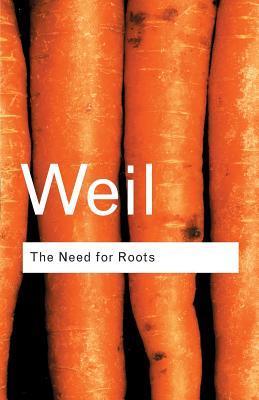
Key Principle
The foundational move of The Need for Roots is the inversion of the modern rights-based political order. Obligations are metaphysically prior to rights: "A man left alone in the universe would have no rights whatever, but he would have obligations" (Part I). Rights are derivative effects, standing to obligations "as between object and subject" (Part I). A right that no one is obligated to honor is politically inert. Every subsequent argument in the book -- that collectivities are instruments, that uprootedness is a crime, that the State has obligations to souls -- depends on this reversal.
From this foundation, Weil identifies fourteen vital needs of the soul, as objective as physical hunger, whose deprivation produces "a state more or less resembling death, more or less akin to a purely vegetative existence" (Part I). The fourteen needs are: order, liberty, obedience, responsibility, equality, hierarchism, honour, punishment, freedom of opinion, security, risk, private property, collective property, and truth (Part I). These needs come in antithetical pairs -- liberty/obedience, security/risk, equality/hierarchism, private property/collective property -- and the critical structural claim is that both poles of each pair must be fully satisfied, not compromised.
Why This Matters
The stakes are civilizational. A political order built on rights without grounding obligations produces demands without corresponding fulfillment -- competing claims with no principled way to adjudicate between them, because the prior question is never asked: who owes what to whom, and why? The men of 1789, recognizing only the human plane and not the eternal source of obligation, built their order on rights alone. This produced "a confusion of language and ideas which is largely responsible for the present political and social confusion" (Part I).
The book's three-part structure embodies this diagnostic logic: Part I defines the needs of the soul (the standard), Part II shows how modern civilization systematically denies them (uprootedness), and Part III prescribes restoration (the growing of roots). Without the normative anthropology of Part I, uprootedness cannot be identified as pathological rather than merely different.
The antithetical-pair structure diagnoses why single-value ideologies destroy what they claim to save. Revolutionary egalitarianism crushes legitimate hierarchy; authoritarian order annihilates liberty. The standard liberal compromise -- moderate liberty and moderate obedience -- is equally pathological, because it systematically starves both poles. The "golden mean" that partially satisfies each is a caricature of what Weil means: "contrary needs are each fully satisfied in turn" (Part I). The disease of uprootedness reproduces itself through every one-sided solution.
Good Examples
Collectivities as soul-food: "We owe a cornfield respect, not because of itself, but because it is food for mankind. In the same way, we owe our respect to a collectivity, of whatever kind -- country, family or any other -- not for itself, but because it is food for a certain number of human souls" (Part I). A collectivity that fails to nourish souls forfeits its claim to loyalty. This is the hinge connecting the needs of the soul to the diagnosis of uprootedness: when collectivities stop nourishing, they uproot.
The defeat of intelligence by "we": "Intelligence resides solely in the human being, individually considered. There is no such thing as a collective exercise of the intelligence" (Part I). When thought is preceded by the word "we," it submits to group opinion rather than truth. Political parties, which demand collective thought, thereby destroy the republic. This explains why propaganda works: it substitutes collective identity for individual judgment. "When the light of the intelligence grows dim, it is not very long before the love of good becomes lost" (Part I). Weil follows Rousseau in proposing the abolition of political parties as a consequence.
France's collapse in 1940: The entire diagnostic arc -- needs defined, then systematically denied -- culminates in the image of a rootless nation unable to resist. "A tree whose roots are almost entirely eaten away falls at the first blow" (Part II). Every class in France was uprooted by 1940: workers by wages and factories, the middle class by cosmopolitan wealth, peasants by money's encroachment and war. The two great instruments of uprootedness -- money and modern education -- operated in tandem: money became "the sole, or almost the sole, motive of all actions, the sole, or almost the sole, measure of all things," while education severed culture from popular tradition and became "a culture which has developed in a very restricted medium, removed from the world, in a stove-pipe atmosphere" (Part I, Part II).
Counterpoints
The enumeration problem: Weil asserts fourteen needs of the soul but provides no systematic derivation for why these fourteen and not others. The list has the force of prophetic declaration rather than philosophical argument, which leaves the framework vulnerable to the charge of arbitrariness. One must accept her anthropology on something closer to moral perception than deductive proof.
Full satisfaction of both poles -- how?: The demand that contrary needs be "each fully satisfied" rather than compromised is the book's most structurally ambitious claim and its most practically obscure. Weil offers the principle but leaves the institutional question largely to Part III. The risk is that the framework becomes a diagnostic instrument that can identify failure in any actual society without specifying what success would look like.
Obligations without a rights floor: If rights are merely derivative, there is no independent check on what obligations a community might impose in the name of soul-nourishment. Eliot notes Weil is "more truly a lover of order and hierarchy than most of those who call themselves Conservative" (Preface) -- the framework could be read as licensing paternalism unless the needs of the soul are rigorously honored as constraints.
Key Quotes
"The notion of obligations comes before that of rights, which is subordinate and relative to the former. A right is not effectual by itself, but only in relation to the obligation to which it corresponds." -- Simone Weil, Part I
"A man left alone in the universe would have no rights whatever, but he would have obligations." -- Simone Weil, Part I
"The intelligence is defeated as soon as the expression of one's thoughts is preceded, explicitly or implicitly, by the little word 'we'. And when the light of the intelligence grows dim, it is not very long before the love of good becomes lost." -- Simone Weil, Part I
"Whoever is uprooted himself uproots others. Whoever is rooted himself doesn't uproot others." -- Simone Weil, Part II
Rules of Thumb
- When diagnosing a political or social failure, ask first what obligation was left unfulfilled, not what right was violated.
- When a value-pair appears (liberty/obedience, equality/hierarchy), check whether one pole has been maximized at the expense of its contrary -- the resulting deformation will be characteristic and predictable.
- Treat collectivities as instruments for nourishing souls, never as ends; a community that devours its members is diseased regardless of its other achievements.
- Beware the self-propagation of uprootedness: "Whoever is uprooted himself uproots others" (Part II). The disease is contagious, not merely local.
- Distinguish between two things called "revolution": one that seeks to give the uprooted roots, and one that spreads uprootedness to all of society (Part II). The second is more frequent.
Related References
- The Antithetical Pairs - structural logic of paired needs
- Collectivities as Soul-Food - communities as nourishment