Key Principle
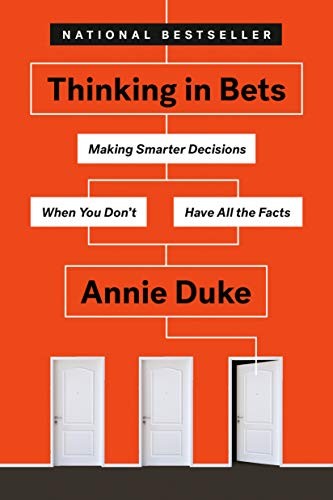
There is no miracle cure here. Thinking in bets does not make you "an always-rational, emotion-free decision-maker," and it does not make self-serving bias or motivated reasoning disappear (Ch. 3). It only moves you "toward objectivity, accuracy, and open-mindedness," and "that movement compounds over time" (Introduction). Because awareness alone never dissolves bias — you still see the Müller-Lyer lines as unequal even after measuring them — the entire program works by building external tools and habit substitution, not willpower (Ch. 1, 2, 4). Adopt it the way you'd correct a one-degree heading error on a New York-to-London voyage: barely noticeable at the start, but uncorrected it "would miss London by miles" (Ch. 3).
"Thinking in bets is not a miracle cure... But it will make those things better. And a little bit better is all we need to transform our lives." — Annie Duke, Chapter 3
A Prioritized Adoption Sequence
Work from highest-leverage and easiest to advanced. Each step has a dedicated reference.
- Catch "resulting" after the fact. After any result, ask: "Was that a good decision or a good outcome?" Use the diagnostic test — imagine the opposite outcome; if your praise/blame flips entirely, you were judging luck, not the decision (Ch. 1). Start here because it is the seed the whole book grows from. See
core-framework.md. - Say "I'm not sure," and state confidence as a number or range. Replace binary "am I confident?" with "how confident?" — a 0-10 scale (or %) or a band of plausible alternatives whose width signals your information quality (Ch. 2). This makes belief-updating emotionally cheap: moving "from 58% to 46%" costs no ego, where "I was right, now I'm wrong" does. See
core-framework.md. - Run the "Wanna bet?" test on your own strong claims. You can't literally bet on everything ("you'd make a lot of enemies"), but train yourself to "view the world through the lens of 'Wanna bet?'" to surface hidden uncertainty before you commit (Ch. 2). See
core-framework.md. - Field every outcome into a skill or luck bucket. Learning = sorting each result into "skill" (steerable) or "luck" (happened to you), then watching for self-serving misfielding — crediting wins to skill, blaming losses on luck (Ch. 3-4). You only need to catch a few more than your prior self to compound ahead. See
core-framework.md. - Recruit a small truthseeking pod with a charter. You cannot de-bias yourself alone; watching others just flips the bias. Charter a group on accuracy, accountability, and diversity, and get explicit buy-in to a truthseeking exchange (Ch. 4). See
the-buddy-system.md. - Adopt CUDOS + outcome-blind analysis in groups. Run Merton's norms — Communism (share all data), Universalism (judge ideas not messengers), Disinterestedness (guard against known outcomes/conflicts), Organized Skepticism — plus outcome-blind review and engineered dissent (Ch. 5). See
the-buddy-system.md. - Install solo precommitment tools. Ulysses contracts (decision-interrupts set by your calm past self), 10-10-10 (weigh consequences at 10 minutes / 10 months / 10 years), and a decision swear jar that flags the words biases produce (Ch. 6). See
mental-time-travel.md. - Run backcasting + premortems before big bets. Map the range of futures with probabilities, then work backward from imagined success (backcasting) and imagined failure (premortem) — quality precommitments depend on quality reconnaissance (Ch. 6). See
mental-time-travel.md.
Why this order. Steps 1-4 are solo, no-overhead, and high-leverage — they retrain how you read outcomes and are the prerequisite mental model for everything else (resulting is what happens when you apply chess-thinking to a poker world). Steps 5-6 add other people, which accelerates de-biasing you cannot do alone but require recruiting and chartering, so they come once the solo frame is in place. Steps 7-8 are the most advanced: they recruit your own past and future selves and presuppose you already know how to field outcomes and tolerate uncertainty. The book itself unfolds in this order, with each chapter naming the next as the remedy to a problem it has just exposed (Ch. 2 "identifies the target"; tools arrive in Ch. 3-6).
How to Run the Hardest Steps
- Outcome-fielding session (step 4): take a recent result, ask "how much of this was the decision and how much was variance?", and assign a rough skill/luck split before you know whether you feel good or bad about it. The fielding error to hunt for is the predictable one: your own wins drifting into the skill bucket, your own losses into luck (and the reverse for rivals) (Ch. 3-4).
- Chartering a pod (step 5): agree out loud, in advance, that members may challenge each other's fielding — this is the consent that prevents Lettermanning. Recruit for genuine disagreement, not comfort; the "red pill" cost is real, so the charter exists to keep the group choosing accuracy over comfort when it stings (Ch. 4).
- Premortem (step 8): imagine the bet has already failed and ask why — this surfaces the "negative space" futures optimism hides. Pair it with backcasting from imagined success. Treat D-Day as the model: planners mapped weather delays, comms failure, and scattered paratroopers; "all those things did go wrong," yet it succeeded because each had been planned for (Ch. 6).
Adherence Strategies
- Reshape the habit loop; don't fight it. Keep the cue and the reward, swap only the routine — substitute a truthseeking response for the self-serving one (Ch. 4). You are not trying to delete a habit, which is why this is realistic.
- Get consent before truthseeking. A perfectly accurate insight delivered to someone who never agreed to the exchange gets "recoded as an insult" — this is why the pod must be chartered and opt-in (Ch. 4).
- Let the group get into your head. Internalized group approval becomes self-accountability: members start anticipating the pod's questions, so you "become your own decision buddy" even when alone (Ch. 5 → Ch. 6).
- Use jargon and labels to make states recognizable. Naming a state — "tilt" for emotionally-compromised decisions, or a swear-jar word list — converts an invisible internal state into a catchable external signal you can act on (Ch. 6).
- Lower friction, not raise walls. Precommitments work by inserting a decision-interrupt, not by being tamper-proof; even small friction (throwing out the junk food so midnight-you must leave the house) reintroduces deliberation (Ch. 6).
- Build in enforcement for the moments you can't trust yourself. Even Ulysses, lashed to the mast, signaled to be freed when he heard the Sirens; the contract held only because his crew enforced it. Some precommitments need another person to hold the line — an advisor who reminds the panicking client of the buy/sell rule the client set themselves (Ch. 6).
- Externalize the conflict of interest in your own speech. Don't state your conclusion or reveal the outcome before asking for input — doing so contaminates the advice you get back. This is disinterestedness (from CUDOS) turned inward as a solo self-audit (Ch. 5, 6).
Common Execution Pitfalls
- Trying to fix bias with willpower or awareness alone. Awareness doesn't dissolve the illusion; intelligence can worsen motivated reasoning. Use external tools and habit substitution instead (Ch. 1, 2, 4).
- Truth-telling without consent (Lettermanning). Offering an accurate alternative hypothesis to someone who never agreed to a truthseeking exchange backfires regardless of accuracy (Ch. 4).
- Building a homogeneous pod. A group without real diversity just amplifies shared bias; diversity is a chartered requirement, not a nicety (Ch. 4-5).
- Running premortems only after optimism has locked in. Imagine failure before committing; once you're invested, the exercise loses its inoculating power against resulting and hindsight bias (Ch. 6).
- Treating confidence as binary. "Right/wrong" filing makes every update an ego event you'll resist; almost "nothing is black and white," so grade it (Ch. 2).
- Resulting on your own past decisions. The Monday-Morning-Quarterback runs internally too — asked for their best/worst decisions, people describe best/worst results (Ch. 1).
- Saying "wrong" as if it were an analysis. "'Wrong' is a conclusion, not a rationale" — it violates organized skepticism and shuts down probabilistic discussion (Ch. 6).
- Expecting a miracle cure rather than marginal gains. The perfectionism trap: when any error reads as failure of the method, you abandon the method. Compete against your prior self and against non-learners, not against perfection (Ch. 1, 3).
Key Quotes
"Thinking in bets starts with recognizing that there are exactly two things that determine how our lives turn out: the quality of our decisions and luck." — Annie Duke, Introduction
"We would be better served as communicators and decision-makers if we thought less about whether we are confident in our beliefs and more about how confident we are." — Annie Duke, Chapter 2 ("Redefining confidence")
"His mistake was offering up the insight in an inappropriate forum to someone who hadn't agreed to that kind of truthseeking exchange." — Annie Duke, Chapter 4
"Better precommitment contracts result from better anticipation of what the future might look like... That takes thoughtful reconnaissance." — Annie Duke, Chapter 6
Related References
- core framework - Resulting, decisions-as-bets, confidence calibration, and outcome-fielding — steps 1-4 of the sequence.
- The Buddy System: Truthseeking Pods - Chartered truthseeking pods, consent/Lettermanning, and CUDOS group norms — steps 5-6.
- Mental Time Travel: Beating Tilt & the Present - Ulysses contracts, 10-10-10, the swear jar, backcasting, and premortems — steps 7-8.