Key Principle
This cluster addresses the gap between intention and execution — the most common failure point in behavior change. Knowing what to do, intending to do it, and actually doing it under real-world conditions are three separate problems. Each requires different BCTs.
BCT 1.4 — Implementation Intentions (Peter Gollwitzer): The "if-then" plan — "If [situation X], then I'll do [behavior Y]." The mechanism: by pre-deciding the response to a specific trigger, the behavior is activated automatically when the cue appears. This eliminates the in-the-moment cognitive load of deciding what to do. The critical design principle: learners must self-generate their implementation intentions — externally assigned plans have significantly weaker effects. The designer's role is to structure the planning exercise, not prescribe the plan.
BCT 8.3 — Habit Formation: Creating a behavioral routine linked to a specific cue. The habit loop: Cue → Routine → Reward. Automaticity (the behavior requiring minimal cognitive effort) builds through repetition. The Gery Model distinguishes stages: Unconscious Incompetence → Conscious Incompetence → Conscious Competence → Unconscious Competence. The design goal is Unconscious Competence — automaticity that frees cognitive resources. But fluency (smooth execution) comes before full automaticity and is a legitimate practice target in itself.
BCT 8.2 — Behavior Substitution: Replacing an unwanted habitual behavior with a wanted or neutral one, paired to the same cue. Works because habits cannot be deleted — only replaced. The replacement behavior must be reinforcing enough to sustain repetition.
BCT 8.4 — Habit Reversal: Rehearsing an alternative behavior to replace an existing habit's cue-response pairing. More intensive than substitution; used when the unwanted habit has a strong established cue.
BCT 2.4 — Self-Monitoring: Tracking one's own behavior to generate awareness and accountability. Most effective when: (1) the measurement is meaningful (not a proxy), (2) the learner sees patterns over time rather than single data points, and (3) there is a feedback mechanism (not just logging for its own sake). The performance-dip risk: self-monitoring often reveals a gap between felt competence and actual performance — this dip in self-assessment can prematurely kill initiatives if not anticipated and framed correctly.
BCT 4.4 — Behavioral Experiments: Testing one's behavior in a real-world context to generate genuine feedback about what works. Used after training, not during. The correct sequencing: design → implement → behavioral experiment → adjust. Running experiments before implementation commits puts the cart before the horse.
Why This Matters
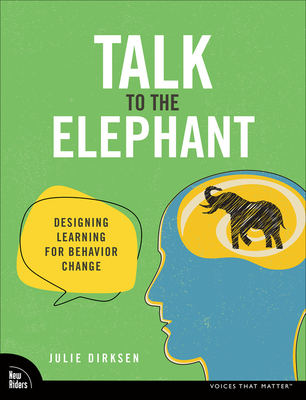
The intention-execution gap is structural. The Rider forms the intention during training; the Elephant encounters the real-world context hours, days, or weeks later. Without implementation intentions linking the trigger to the response, the Elephant reverts to its existing automatic patterns. The Rider "remembers" the intention in quiet moments; the Elephant does not activate it in the moment of action.
BCT 1.8/1.9 — Behavioral Contracts / Commitment: Public or written commitment to perform a behavior. Strong causal mechanism (commitment consistency principle), BUT: if the learner does not genuinely want to be accountable, imposed contracts trigger reactance — the Elephant actively resists the behavior to reassert autonomy. Do NOT use in mandatory or compliance-heavy contexts unless learner buy-in is genuinely present.
Buddy Systems and BCT 3.2 (Social Support): Social accountability works through the presence of another person, not through the quality of their expertise. The design distinction: buddy structures should focus learners on a shared behavioral task (not mutual cheerleading) and should be framed as social presence (support) rather than social evaluation (judgment). Evaluation framing triggers performance anxiety; support framing enables psychological safety.
Gamification and repetition volume (Chapter 10): Gamification works when it dramatically increases the volume of practice repetitions (the Elephant needs many trials to build automaticity). It fails when it is treated as an engagement substitute for practice — making a single exposure "fun" does not produce automaticity. The measure of gamification's value is: did it increase the number of practice reps?
Good Examples
Project ALERT substance-use prevention (Chapter 10): The program that produced behavior change over plain information delivery did not add more information — it added practice and implementation intentions. Students were asked to generate if-then plans for the specific moments when they would be offered substances by peers. The moment the cue appeared in real life, the response was pre-decided. Information-only versions of the program had no behavioral effect.
Streak mechanics (Chapter 10): Streak systems (e.g., consecutive-day practice tracking) motivate not through the magnitude of any single streak but through loss aversion — breaking a streak feels worse than never starting one. The design implication: streak design should preserve recovery (allowing one missed day without breaking the streak) to prevent abandonment after the first miss.
Performance dip and measurement (Chapter 10): When self-monitoring (BCT 2.4) reveals that a skilled but unmonitored behavior was actually being performed incorrectly, performance appears to drop. In reality, measurement accuracy has improved. Organizations that kill training initiatives based on this "dip" are optimizing for the comfort of not knowing rather than for genuine performance improvement.
Counterpoints
"Practice is built into the training module" — practice within the training event builds Conscious Competence but not Unconscious Competence (automaticity). Real-world automaticity requires extended repetition in the actual performance context, with real cues, real distractors, and real stakes. Simulated practice is a necessary but not sufficient predecessor.
"We'll run a pilot to see if it works" — a pilot tests whether implementation was successful. A behavioral experiment (BCT 4.4) tests whether the specific behavior change occurred. They are different questions requiring different designs. Most "pilots" measure reach and satisfaction, not behavioral outcomes.
Key Quotes
"The planning gap — the space between 'I intend to' and 'I will when X happens' — is where most behavior change initiatives fail." — Julie Dirksen, Chapter 10: Using Planning, Practice, and Feedback
"You're not trying to get them to remember the right answer. You're trying to get them to build the right habit." — Julie Dirksen, Chapter 10: Using Planning, Practice, and Feedback
Rules of Thumb
- Use implementation intentions for any behavior with a specific, identifiable trigger. Have learners generate their own if-then plans — don't write them for learners.
- Do not use BCT 1.8/1.9 (Behavioral Contracts) unless the learner genuinely wants accountability. Imposed contracts backfire.
- Practice must target automaticity, not just accuracy. Volume of repetitions matters as much as quality of each repetition.
- Schedule behavioral experiments (BCT 4.4) as a post-implementation phase, not as a pre-implementation test.
- When introducing self-monitoring (BCT 2.4), pre-brief learners on the performance dip effect so they interpret decreased scores as increased measurement accuracy, not decreased capability.
- Gamification works only if it increases practice volume. If it adds a layer of engagement without increasing repetitions, it adds complexity without benefit.
Related References
- Persuasion and Motivation BCTs (Chapter 9) — Goals BCTs (1.1, 1.2) precede implementation intentions (1.4)
- Environmental and Social Support BCTs (Chapter 11) — Social support BCTs complement habit-formation by providing accountability
- Designing Responsibly: Ethical Framework for Behavior Change — Iterative learner testing is the ethical analog to behavioral experiments