Key Principle
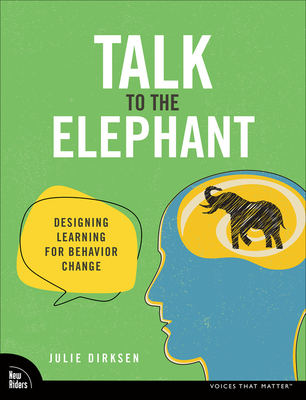
Behavior is governed by two cognitive systems simultaneously: the Rider (deliberate, verbal, logical — Kahneman's System 2) and the Elephant (automatic, emotional, habitual — System 1). The Rider can plan, reason, and form intentions. The Elephant actually executes moment-to-moment behavior through gut reactions, ingrained routines, and emotional responses. Most learning design addresses only the Rider — delivering information, making arguments, issuing instructions. The Elephant neither understands nor responds to these signals. The result is the knowing-doing gap: people know what they should do and still don't do it.
The second foundational insight is systemic: behavior is always produced by the surrounding system of incentives, environments, social norms, and feedback loops — not by individual character. "Every system is perfectly designed to get the results it gets." Training individuals while leaving systemic factors intact produces temporary Rider compliance that collapses when willpower runs out.
Why This Matters
The Louder-and-More-Emphatically Fallacy is the default failure mode of instructional design: when behavior doesn't change after training, the reflexive response is more training, clearer instructions, or stronger warnings. This fails because information delivery was not the bottleneck. The Rider already understood. The Elephant was never reached.
Rider-Dragging — using willpower to override the Elephant — works briefly but is energetically unsustainable. Every behavior-change initiative that relies on willpower, rational intent, or "just try harder" produces short-term compliance followed by relapse. The Elephant always wins in the long run because it requires no effort to maintain automatic patterns.
The Fundamental Attribution Error compounds this problem at the design level: designers attribute non-compliance to character (laziness, stubbornness, not caring) rather than to systemic or motivational root causes. This misdiagnosis leads to interventions that fix the wrong thing.
Good Examples
HIV/AIDS prevention (Chapter 1): Healthcare workers understood HIV transmission perfectly — knowledge was not the gap. Sexual behavior remained unchanged because risk perception, social norms, and automatic behavioral patterns (the Elephant) were never addressed. Information delivery failed completely.
Starbucks racial-bias training (Chapter 2): Closing all 8,000 US stores for a single day of training to address racial bias assumed the problem was knowledge. But racial bias is an automatic system — the Elephant's pattern-matching — that training alone cannot overwrite. The surrounding system of incentives, social accountability, and environmental cues was left intact. Durable change requires systemic intervention, not a one-day event.
Handwashing compliance (Chapter 2): Healthcare workers know handwashing prevents infection. Compliance in ICUs has historically been poor. The Elephant cannot perceive germs — the consequence is invisible and delayed. Every handwash requires a Rider override. No sustainable system can rely on repeated Rider override; the environment must be redesigned so the Elephant doesn't need to be overridden.
Counterpoints
"Just make the case strongly enough" assumes the Rider controls behavior under all conditions. It does not. Under time pressure, emotional stress, or habit activation, the Elephant takes over. Rational arguments arrive after the behavior has already occurred and the Rider rationalizes it.
"Train the individuals, not the system" is efficient to plan and cheap to execute, but fails when the problem is systemic. Pay equity policy (Chapter 2) cannot be fixed by training individuals about bias if the organizational incentive structure rewards biased decisions. Environmental change, policy change, and social norm shifts are required.
"The training was good — they just didn't apply it" is the post-hoc rationalization that avoids diagnosing what actually blocked application. Application failure is a design failure: either the Elephant wasn't engaged, or systemic barriers were never identified and removed.
Key Quotes
"Your Rider is vastly outnumbered and outgunned. For every one neuron your cortex has, your amygdala has ten." — Julie Dirksen, Chapter 1: Talking to the Elephant
"Every system is perfectly designed to get the results it gets." — Julie Dirksen, Chapter 2: Taking a Systems View
"If you want to change behavior, you need to understand what the behavior is for." — Julie Dirksen, Chapter 1: Talking to the Elephant
Rules of Thumb
- Before designing any intervention, ask: "Is this a Rider problem (information, reasoning) or an Elephant problem (automatic response, habit, emotion, environment)?" Most persistent behavior gaps are Elephant problems.
- If training failed before, do not assume more training will succeed. Diagnose what the Rider-only approach missed.
- Identify the system producing the unwanted behavior. Ask what would have to change in the environment, incentives, or social norms — not just in the individual — for the desired behavior to become the path of least resistance.
- Assume the Fundamental Attribution Error is operating in your diagnosis. Reframe "why aren't they doing it?" from character to circumstance.
Related References
- COM-B Diagnosis and Behavior Analysis — Structured diagnostic framework for identifying which specific Rider/Elephant/system factor is the root cause
- Mapping COM-B to Intervention Types and BCTs — How COM-B diagnosis maps to intervention types targeting Rider vs. Elephant vs. environment
- Environmental and Social Support BCTs (Chapter 11) — BCTs for the systemic/environmental dimension