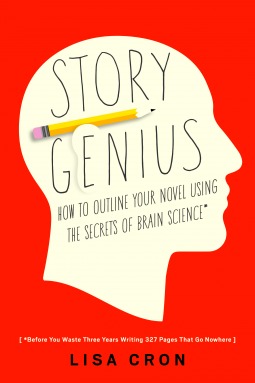
Key Principle
The Story Genius method builds a novel from the inside out: protagonist's internal struggle first, plot second, prose last. The blueprinting system produces "a fully realized synthesis of the internal and external layers of your story from beginning to end" -- not a plot outline but an integrated document where internal causation drives every scene. "Nothing in this process goes to waste. None of it is 'prewriting.'" -- Lisa Cron, Introduction
Why This Matters
Writers who start with plot, prose, or external structure models all fail for the same reason: they focus on externals while neglecting the protagonist's internal struggle. "The very fact that you can move things around is a telltale sign that the novel has no internal logic." -- Lisa Cron, Chapter 2. This playbook sequences the work so that each step generates the material needed by the next.
Step-by-Step Workflow
Step 1: Identify the What If + The Point (Ch. 3)
- Find the "first pinprick" -- a surprising image, question, or conviction.
- Burrow into why you care. Identify your point about human nature.
- Draft a What If that includes context, surprise, conflict, and internal consequences.
- Pitfall: A neutral What If (surprising premise, no point) generates "a string of equally dramatic, random, pointless events." The point is what makes the What If generative.
Step 2: Choose the Protagonist (Ch. 4)
- The right protagonist is the one whose transformation embodies the point most sharply.
- In multi-POV novels, identify the alpha-protagonist whose story gives meaning to all others.
- Pitfall: Choosing the character with the most external drama rather than the one who best embodies the point. "No one ever asked, 'Whose plot is it?'" -- Lisa Cron, Chapter 4
Step 3: Unearth Desire + Misbelief (Ch. 5)
- Concretize the desire: use the "eyes wide shut" test -- if you cannot close your eyes and envision it, it is not specific enough.
- Define the misbelief: something the protagonist honestly believes to be true that is wrong, that was once adaptive, and that now prevents achieving the desire.
- Together, desire and misbelief form the third rail. "It is from those two small, burning embers that all stories grow and flame." -- Lisa Cron, Chapter 5
- Pitfall: Vague desire ("I want to be happy") generates no story. Full character biographies are "chock-full of surface 'what' with almost no internal 'why.'"
Step 4: Write the Origin Scene (Ch. 6)
- Write the scene when the misbelief first took root, from inside the protagonist's head.
- Answer four questions before writing: (1) What does she believe going in? (2) Why? (3) What is her goal? (4) What does she expect?
- Write in first person even for third-person novels -- it forces interiority.
- Pitfall: Writing a "general specific" -- naming the event without capturing what the protagonist concluded about human nature in that moment. "Specifics play forward; generalities don't." -- Lisa Cron, Chapter 6
Step 5: Write Three Turning-Point Backstory Scenes (Ch. 7)
- Three scenes between origin and page one where the misbelief was the deciding factor.
- Selection criteria: (1) Protagonist at a crossroads, (2) escalating ramifications, (3) misbelief tipped the scales, (4) she had a real shot but the misbelief prevented it.
- Link everything with "therefore/but" -- never "and then."
- Pitfall: Leaping from origin to page one. Without accumulated backstory, the protagonist has no specific memories to draw on and no internal logic for present decisions.
Step 6: Identify the Opening (Ch. 8)
- Define homeostasis: the protagonist's current equilibrium, however miserable.
- Identify the unavoidable external force that overrides resistance to change.
- Establish the ticking clock: a specific deadline counting down to a concrete consequence.
- Apply the Two-Test System: External (can it build? specific consequence? deadline?) and Internal (forces misbelief struggle? costs something emotionally?).
- Pitfall: A problem that passes only the external test produces plot without story. "If the protagonist can simply decide to give up without suffering great personal cost due to her inaction, you do not have a story." -- Lisa Cron, Chapter 8
Step 7: Define the "Aha!" Moment (Ch. 10)
- Write the moment the misbelief finally breaks -- the true ending, distinct from the external resolution.
- Know this before drafting. "Writers very often stop writing after the first twenty pages because they have no idea what comes next." -- Lisa Cron, Chapter 10
- Three principles: let the protagonist earn it, put the reader in the triggering event, stay inside the protagonist.
- Pitfall: Envisioning the ending as external plot resolution only, producing a climax that is "technically complete but emotionally inert."
Step 8: Build Scene Cards (Ch. 9, 11)
- For each scene, track: Alpha Point (external necessity), Cause (plot + third rail), Effect (plot + internal change), And So? (concrete next action).
- Organize using the six-folder system: Idea List, Random Scene Cards, Scene Cards in Development, Scenes, Key Characters, Rules of the World.
- Fully flesh out cards for the first five scenes plus the last scene before writing prose.
- Pitfall: Traditional index cards that track only external events and encourage random rearrangement, destroying causal logic.
Step 9: Apply the Three "Why" Tests (Ch. 13)
- Every plot point must clear: (1) Why does my plot need it? (2) Logistically, why can it happen? (3) Why would it happen given the protagonist's inner struggle?
- Use the tests as generators, not just filters -- each answer produces new specifics.
- Pitfall: Running with untested plot points and building hundreds of pages on a faulty foundation.
Step 10: Layer Subplots (Ch. 14)
- Mine subplots from two sources: external events already in motion, and secondary characters' agendas.
- Every secondary character needs a story-specific bio: a cause-and-effect trajectory relevant to the protagonist's journey.
- Track subplots by character on Scene Cards.
- Pitfall: Adding subplots that do not connect to the protagonist's struggle, creating false reader expectations and narrative dead weight.
Step 11: Write Forward in Spirals (Ch. 15)
- Write scenes in chronological order. Apply the three secrets: strategic conclusions from everything noticed, emotion without naming it, constant subjective mind-set.
- Revise in spirals: circle back to the beginning regularly to layer in discoveries from later scenes.
- Pitfall: Writing linearly without circling back. Seeds needed in early scenes are only discovered when writing later ones. "Nothing is written in stone; it's sculpted in clay." -- Lisa Cron, Chapter 15
Key Quotes
"Story is not about the plot, or what happens. Story is about how the things that happen in the plot affect the protagonist, and how he or she changes internally as a result." -- Lisa Cron, Introduction
"You have to know everything there is to know about the protagonist's specific internal problem before you create the plot, and why this knowledge will then, with astonishing speed, begin to generate the plot itself." -- Lisa Cron, Introduction
"The conventions of writing -- voice, structure, drama, plot, all of it -- are the handmaiden of story, not the other way around." -- Lisa Cron, Chapter 2
Rules of Thumb
- Internal before external, always -- the protagonist's struggle generates the plot, not the reverse
- Each step generates material for the next; skipping a step means the downstream work has no foundation
- The blueprint is not prewriting -- much of it becomes first-draft prose
- When stuck at any step, ask "Why?" and do not stop until you reach a true specific
Diagram

Related References
- Story Logic: The Three 'Why' Tests - Deep dive on Step 9
- Subplots, Storylines, and Secondary Characters - Deep dive on Step 10
- Writing Forward: Making the Invisible Visible - Deep dive on Step 11
- Rules of Thumb - Quick-reference heuristics for every step