Key Principle
Design must operate at the level of ideology -- complete worldviews and belief systems -- not merely at the level of products. "Technology is as much an embodiment of ideology, politics, and culture as science. One can't help but wonder if ideology is at the source of true innovation" (Chapter 9). If you want radically different outcomes, you need radically different premises. Incremental optimization within a shared worldview produces convergent technology.
Why This Matters
Most design operates within an unexamined ideology. When designers only work on objects, they inherit the reigning ideology invisibly. Making ideology explicit as design material forces examination of the worldview a design embodies. Without this, even "radical" design proposals merely rearrange furniture within the same room.
The stakes are existential. "As we rapidly move toward a monoculture that makes imagining genuine alternatives almost impossible, we need to experiment with ways of developing new and distinctive worldviews that include different beliefs, values, ideals, hopes, and fears from today's. If our belief systems and ideas don't change, then reality won't change either" (Chapter 9). Social limits are self-referential: changing beliefs about possibility changes possibility itself.
Good Examples
United Micro Kingdoms (Dunne & Raby): England divided into four ideological zones, each expressed through vehicle design. A political compass (left/right economics, authoritarian/libertarian personal freedom) paired with energy technologies creates four fictional micro-kingdoms: Communism + Nuclear, Social democracy + Biotech, Neoliberalism + Digital, Anarchy + Self-experimentation. Each vehicle embodies a complete political-economic system -- "not exactly a metaphor, more a synecdoche" (Chapter 9). Transport was chosen because vehicles are "highly charged symbols of freedom and individuality" (Chapter 9), combining technology, products, and infrastructure in a single object category.
Digitarians (UMK): The most dystopian yet familiar kingdom. The car becomes "an interface for navigating tariffs and markets" rather than space. Status markers shift from power and speed to a "P5 Index" based on "price, pace, proxemics, priority, and privacy" (Chapter 9). Citizens are governed by "technocrats or algorithms -- no one is entirely sure or cares -- as long as everything runs smoothly and people are presented with choices, even if illusionary" (Chapter 9). Speculative critique works precisely because the scenario is already recognizable. "Digitarians are already among us and their mind-set is shaping the world around us. How far are we prepared to let it spread?" (Chapter 9).
Bioliberals and Anarcho-Evolutionists (UMK): The Bioliberals reframe speed and energy expenditure as primitive: "Bioliberals regard the use of huge amounts of energy to overcome gravity and wind resistance to be counterproductive and primitive. Faster is no longer better" (Chapter 9). The Anarcho-Evolutionists invert the default design assumption: "They believe that humans should modify themselves to exist within the limits of the planet rather than modifying the planet to meet their ever-growing needs" (Chapter 9). Both demonstrate that fully embracing an alternative technology forces the entire surrounding value system to change.
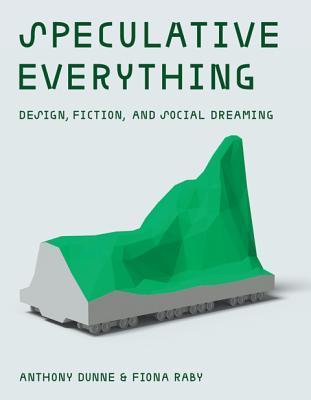
Communo-Nuclearists (UMK): A no-growth micro-state on a nuclear-powered, 3km-long mobile train. Inhabitants are "voluntary prisoners of pleasure, free from the pressures of daily survival." The most technologically dependent society produces the most naturalized environment -- irreconcilable tensions embedded so viewers cannot passively accept or reject the proposal. The train is "designed to be suggestive, for people to wonder what might lie inside the mountains, how it would work, and what it would be like to live on" (Chapter 9).
Counterpoints
Substitution vs. transformation. Current approaches to alternative technology (e.g., algae biofuel replacing petrol) aim to change the fuel while preserving existing infrastructure, aesthetics, and values. This is substitution, not transformation. "This is a visual expression of what needs to change if we are to develop new ways of existing based on new values" (Chapter 9). If you only substitute inputs, existing values remain invisible and unchallenged. The substitution-vs-transformation distinction is the methodological core: design that merely swaps inputs while preserving forms reinforces the status quo.
Think tanks as innovation blockers. Institutions nominally dedicated to new worldviews may function as the opposite: "preventing people thinking of new visions of how society could be organised... they have become the armoured shell that surrounds all politics" (Chapter 9, quoting Adam Curtis).
The decline of big dreaming. Contemporary technological imagination has narrowed: "shaped by military priorities or a short-term, market-led view of the world based on standardized consumer dreams" (Chapter 9). Even bold architectural visions "don't seem to include the underlying alternative worldviews and ideology of earlier big thinkers" (Chapter 9). Space travel has been "hypercommodified, becoming just another commercial offer." The social dimension of big thinking "has vanished, replaced by science, technology, and logic" (Chapter 9).
The Soviet Ekranoplan as counterexample. The ground-effect military transport vehicle was developed outside Western ideals and represents a fundamentally different technological imagination rooted in a different ideology. It concretely demonstrates the book's claim that genuine novelty may require genuinely different worldviews -- not just better engineering within existing paradigms (Chapter 9).
Key Quotes
"Large-scale speculative design contests 'official reality'; it is a form of dissent expressed through alternative design proposals." -- Dunne & Raby, Chapter 9
"The days of designers dreaming on behalf of everyone have passed but designers can still facilitate a dreaming process that unlocks people's imaginations." -- Dunne & Raby, Chapter 9
"The actual limits of what is achievable depend in part on the beliefs people hold about what sorts of alternatives are viable." -- Erik Olin Wright, cited in Chapter 9
"For us, ideology is a way of thinking about worldviews and the narrative glue that joins values, beliefs, priorities, hopes, and fears together." -- Dunne & Raby, Chapter 9 Notes
"The idea of the 'proposal' is at the heart of this approach to design: to propose, to suggest, to offer something. Its value is not what it achieves or does but what it is and how it makes people feel." -- Dunne & Raby, Chapter 9
"Rather than offering an easy way forward, it highlights dilemmas and trade-offs between imperfect alternatives. Not a solution, not a 'better' way, just another way. Viewers can make up their own minds." -- Dunne & Raby, Chapter 9
Rules of Thumb
- Design must operate at the level of worldviews, not just objects -- "if our values, mental models, and ethics change, then the world that flows from that worldview will be different" (Chapter 9)
- If your speculative design only changes the technology but preserves the surrounding values, you are doing substitution, not transformation
- Pair a political ideology with a technology to generate a fictional society; swap pairings to generate hybrids -- "but which comes first, technology or ideology?" remains deliberately open (Chapter 9 Notes)
- Ground speculation in a real place -- "a completely imaginary place would lack any connection to the world we currently occupy" (Chapter 9)
- Use trade-off exposure as a design goal: each scenario should force viewers to weigh competing values rather than passively accept or reject
- Leave deliberate gaps in your world -- incompleteness provokes imagination more effectively than comprehensive depiction
- Frame speculation as "micro-kingdoms" or "fables" rather than "hard scenarios based on analysis and reason" to signal imaginative engagement (Chapter 9)
- Embed irreconcilable tensions deliberately so viewers cannot passively accept or reject the proposal -- contradictions are the mechanism, not a flaw
- Norman Bel Geddes over Buckminster Fuller: mix modern technologies with "dreams, fantasy, and the irrational" rather than being purely technological (Chapter 9)
Related References
- Implementation Playbook - How to execute the ideology-level speculation described here
- Rules of Thumb - Collected heuristics including calibration of the real/unreal boundary
- Intellectual Lineage and Key References - Wright, Feenberg, and other thinkers informing ideology-as-material