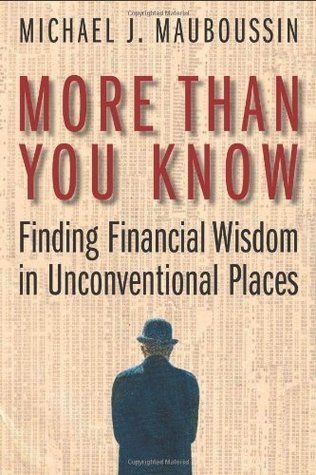
Key Principle
Markets are complex adaptive systems whose behavior emerges from many heterogeneous agents interacting. No single discipline can describe them adequately. The investor's task is threefold: (1) build a latticework of mental models drawn from multiple disciplines, (2) focus on process quality rather than outcome quality, and (3) optimize for expected value — probability-weighted payoffs — rather than frequency of being right.
Alpha comes from variant perception: a well-founded view that differs from the consensus embedded in price. A mental model is "a tool — a framework that helps you understand the problem you face" (Introduction). The goal is selecting the model that fits the problem, not forcing the problem into a familiar model. As Munger warns: do not "torture reality" to fit your model.
Why This Matters
Narrow specialization creates shared blind spots. When investors all use the same models, their errors become correlated and compound rather than cancel. The causal chain: narrow expertise leads to shared blind spots, which produce correlated errors, which cause systematic forecasting failure. Diverse models produce uncorrelated errors that cancel, yielding superior collective judgment.
Standard finance rests on three pillars the CAS framework overturns: agent rationality, normally distributed price changes, and conventional risk/reward metrics. The CAS framework "is not only a much more intuitive way to understand markets but also more consonant with the empirical record" (Introduction). Phil Tetlock's 15-year study found broad thinkers ("foxes") consistently outperformed narrow specialists ("hedgehogs"). Scott Page proved mathematically that cognitive diversity is necessary — not merely helpful — for solving complex problems.
Good Examples
Taleb's short position (Ch. 3): Taleb was short S&P futures despite believing the market would most likely rise. Most probable outcome (70% chance of +1%) and best bet (-3.0% expected from the 30% downside) pointed in opposite directions. Expected value was -2.3%, making the short correct even though direction was "wrong" most of the time.
The nearly fired portfolio manager (Ch. 3): A manager ranked among the best total performers in a group of ~20 but had the worst percentage of stocks beating the benchmark. The treasurer nearly fired him. Frequency- based evaluation systematically eliminates magnitude-driven outperformers.
DePodesta's blackjack analogy (Ch. 1): Hit on 17 and drew a 4 — a good outcome from a terrible decision. The Process vs. Outcome Matrix (Exhibit 1.1) codifies this: Deserved Success, Bad Break, Dumb Luck, Poetic Justice. Evaluating decisions by results alone is a category error.
Counterpoints
Learning across disciplines has uncertain payoff; most cross-domain knowledge may never be directly useful. Mauboussin argues this is tractable because only a few big ideas per discipline carry most of the explanatory weight.
The profession-vs-business tension (Ch. 2) means that even investors who understand expected value face institutional pressure toward frequency- maximizing strategies — index-hugging, short evaluation horizons, consultant courtship (consultants are involved in 70% of institutional manager hiring). Each tactic is individually rational but collectively fatal to performance.
Loss aversion is not a knowledge gap but a hardwiring problem. Kahneman and Tversky showed losses feel approximately 2.5x more painful than equivalent gains. This creates a systematic preference for high-frequency strategies (many small wins) that are not necessarily high-expected-value strategies. The result: portfolios that feel good but underperform.
Key Quotes
"The experts who knew a little about a lot — the diverse thinkers — did better than the experts who knew one big thing." (Introduction, summarizing Tetlock)
"The goal of an investment process is unambiguous: to identify gaps between a company's stock price and its expected value." (Ch. 1)
"The frequency of correctness does not matter; it is the magnitude of correctness that matters." (Ch. 3)
"A quality investment philosophy is like a good diet: it only works if it is sensible over the long haul and you stick with it." (Introduction)
"Any time you make a bet with the best of it, where the odds are in your favor, you have earned something on that bet, whether you actually win or lose the bet." — David Sklansky, The Theory of Poker (Ch. 1 epigraph)
Rules of Thumb
- Process over outcome — Evaluate decisions by method, not result. Use the 2x2 matrix (good/bad process x good/bad outcome) to separate skill from luck.
- Think in expected value — Multiply probability by payoff across all scenarios before acting. The most likely outcome is not the best bet when magnitudes are asymmetric.
- Magnitude over frequency — A few large winners can overwhelm many small losses. Tolerate low hit rates if the payoff structure justifies it.
- Seek variant perception — Only bet when your well-founded view differs from the consensus embedded in price. Agreement with the crowd earns the market return.
- Import mental models broadly — Draw from psychology, biology, network theory, complexity science, and statistics. A few big ideas per discipline.
- Watch for diversity collapse — Market inefficiency arises when investor heterogeneity breaks down, not from individual irrationality.
- Guard against institutional drift — Check whether your firm optimizes for the profession (long horizon, contrarian bets) or the business (asset gathering, index-hugging).
Related References
expected-value-thinking.md— probability-weighted decision-making and the Babe Ruth Effectloss-aversion-and-myopia.md— hardwired biases vs. expected-value discipline (Ch. 8)diversity-breakdown.md— market inefficiency through homogeneity (Ch. 14)complex-adaptive-systems.md— CAS properties, emergence, fat tails (Ch. 31, 34)