Key Principle
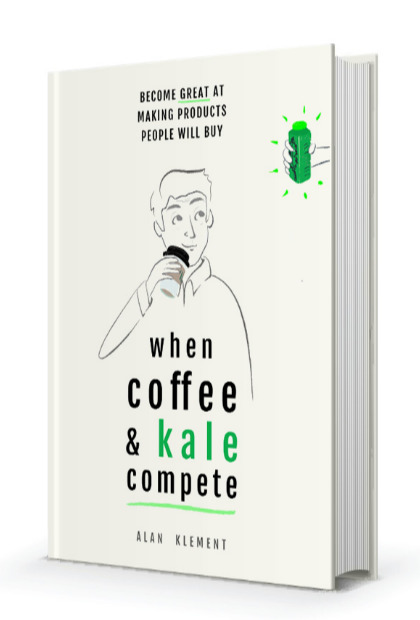
Six case studies reveal a consistent pattern: successful JTBD practice starts by uncovering the customer's emotional struggle and competitive landscape through past behavior, not by asking about features or preferences. Every company that got this right discovered that their real competition, customer segment, and value proposition differed fundamentally from their initial assumptions.
Why This Matters
Teams routinely build for the wrong customer, price against the wrong benchmark, and compete on the wrong dimension -- not from carelessness but from relying on demographics, stated preferences, and category-based analysis. These six cases show that JTBD interviews consistently overturn founding assumptions: Clarity's budget came from conferences not SaaS subscriptions, YourGrocer's customers were mothers not young professionals, and Lean Canvas's most revealing user was a Chilean salmon fisher. The pattern is reliable enough to treat as a rule: your initial model of who the customer is and what they want is almost certainly wrong, and only past-behavior evidence will correct it.
Good Examples
Clarity (Ch. 4-5) -- Dan discovered the Job was not "get expert advice" but "get inspired by someone I respect to escape a slump." Customers' budgets came from conference spending, not software subscriptions, giving Clarity far more pricing power than category analysis suggested. The messenger mattered more than the message, so experts were sourced from SlideShare.
Form Theatricals (Ch. 5) -- Anthony found parents hired children's theater to teach life lessons about independence and teamwork through post-show dinner conversation, not for in-seat entertainment. Non-arts professionals hired off-Broadway for community belonging unavailable in their professional lives. This led to a subscription-cohort model where the cohort, not the show, was the product.
YourGrocer (Ch. 6) -- Morgan's team assumed young professionals; actual customers were young mothers with two or more children whose life circumstances had forced a value shift from quality to convenience. The effective marketing message was not abstract ("high quality") but trust-proxied ("from the local shops you love"). Habits, not rival products, were their biggest competitor.
Transcendent Endeavors (Ch. 8) -- Omer segmented by struggle intensity, not demographics. Surveying broadly across hospital stakeholders, he narrowed to med/surg nurses (high patient volume + high turnover) as the only segment where structural conditions made the adverse-events problem acute. Nurses' own compensatory behaviors (hand-notes evolving into photocopied grid worksheets) revealed the product's shape.
Product People Club (Ch. 9-10) -- Justin mined years of blog comments, newsletter replies, and social media for recurring emotional struggles and found loneliness and motivation paralysis among solopreneurs. A simple page naming the struggle sold out in 30 minutes with a 400-person waitlist. When the first Job was resolved, a downstream struggle (marketing skills) emerged, and he built a separate product rather than bloating the original.
Lean Stack (Ch. 10-11) -- Ash discovered that customers churned not from dissatisfaction but from success: Lean Canvas solved its Job so quickly customers had no reason to return. The response was building a complementary product system (tools, books, training) around the higher-level Job of "become a better entrepreneur," turning episodic use into continuous progress.
Counterpoints
Assuming you know the customer. Both Clarity and YourGrocer built initial products for the wrong segment. Demographics correlated but did not explain hiring behavior. "We thought we were creating a business for young professionals... almost every single one of our customers was a young family." (Ch. 6)
Treating stated preferences as real demand. Clarity customers said they loved the product but had never logged in. Feature validation requires evidence of past workaround behavior, not hypothetical interest. (Ch. 4)
Ignoring anxiety as a competitive force. YourGrocer customers said "I just don't know when my groceries are going to get delivered" despite flexible delivery options -- the anxiety was cognitive, not functional. Form Theatricals found cost-value and social-use anxieties stalling purchases. (Ch. 5-6)
Building for everyone affected rather than those actively struggling. Hospitals, patients, and nurses all wanted fewer adverse events, yet the problem persisted. Only med/surg nurses had the structural conditions that made struggle acute. (Ch. 8)
Key Quotes
"I feel like customers have this really bad habit of lying sometimes. They'll say, 'Yeah. I love your product. I use it all the time.' Then, you look at the logs, and you realize they haven't logged in once since signing up." -- Alan Klement, Chapter 4
"Habits like these are our biggest competition." -- Morgan, Chapter 6
"When we present it as a Job to be Done, the artist has a lot of leeway around what the story should do." -- Anthony, Chapter 5
"When I interview potential customers, I look for evidence of a struggle. I'm looking for an energy to tap into. If a group of people is not struggling -- if I can't feel that energy -- then there's probably no opportunity there." -- Omer Yariv, Chapter 8
"Customers weren't leaving because we were doing a bad job. They were actually leaving because they felt like they had been satisfied." -- Ash Maurya, Chapter 11
"They just wanted to just fucking do it. They wanted to go out and build their own thing, but they were getting stuck." -- Justin Jackson, Chapter 9
Rules of Thumb
- Your initial assumption about who the customer is will be wrong. Interview for past behavior, not demographics.
- Ask "what else did you consider?" to discover cross-category competition that reveals the real Job.
- If no customer has ever attempted a workaround for a problem, there is no Job pulling them toward a feature. Kill it.
- Anxiety is a competitor. Attack it with the same intensity as a rival product.
- Habits recapture customers below conscious awareness. Design onboarding to pre-empt old routines (e.g., YourGrocer's day-3 and day-7 email triggers).
- Satisfied churn is real. If the Job scope is too narrow, customers leave because they succeeded. Build a product system, not a single tool.
- One product, one Job. When a downstream struggle emerges, build a separate product rather than bloating the original.
- Compensatory behaviors (workarounds customers already built) encode the shape of the solution. Study them before designing.
Related References
- JTBD Research and Interview Methods - the research methods these cases demonstrate
- Anxiety, Inertia, and Habits as Silent Competitors - anxiety/habits uncovered in the cases
- Customer-Defined Competition - competition patterns from the cases